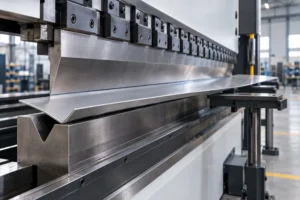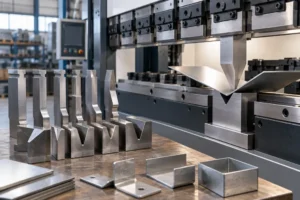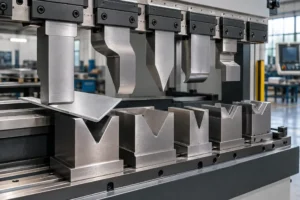
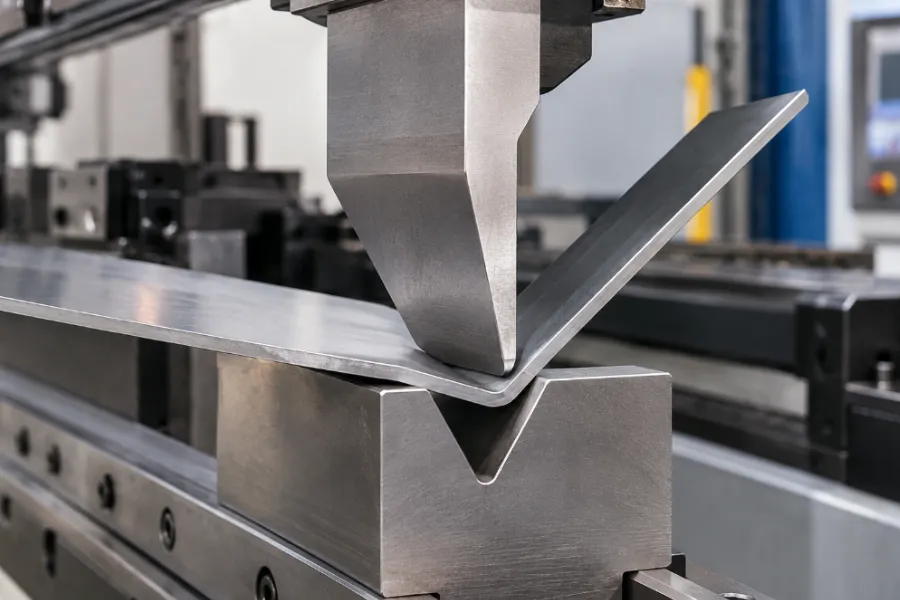
Press brake springback is the elastic recovery that occurs after bending force is released. It usually opens the final bend angle and slightly increases the relaxed inside bend radius.
The amount of springback depends on material strength, material thickness, bend radius, V-die opening, bending method, tooling, and actual material variation. For production work, the most reliable approach is to measure the unloaded angle on the actual material and use that result to establish compensation.
What Is Press Brake Springback?
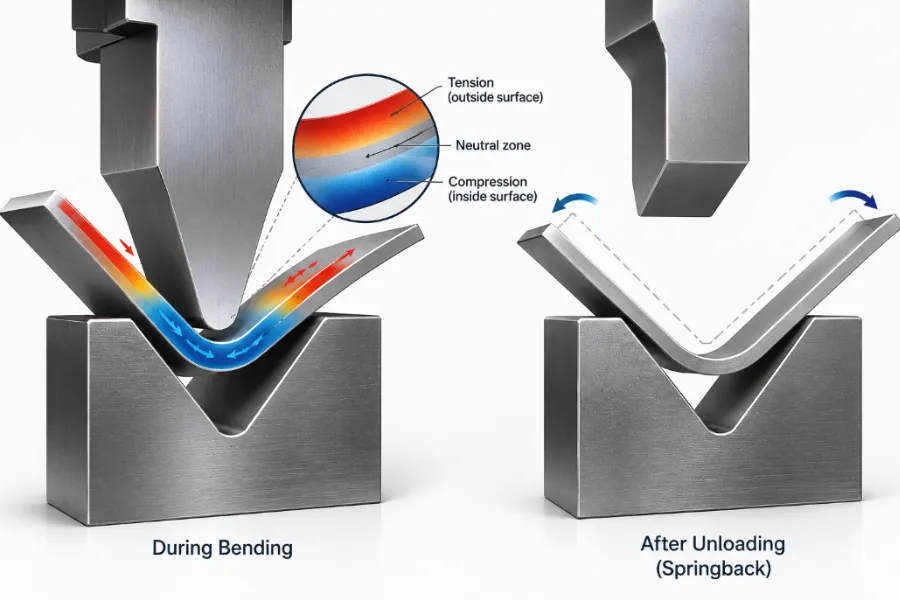
During bending, the inside of the sheet is compressed while the outside is stretched. Once the material exceeds its yield strength, plastic deformation creates the permanent bend, while elastic strain remains within the material.
When the punch releases the load, the elastic portion recovers and changes the final geometry. The angle under load is therefore not necessarily the same as the angle measured after unloading.
Springback also changes the relaxed inside bend radius. This radius change can affect bend allowance, bend deduction, and flat-pattern calculations when dimensional tolerances are tight.
What Causes More Press Brake Springback?
Material Strength
Yield strength is one of the strongest influences on springback. Higher-strength materials generally retain more elastic recovery after unloading, which is why stainless steel and high-strength steels often require greater compensation than conventional mild steel under comparable conditions.
Material grade alone does not determine the required correction. Actual yield strength, material condition, thickness, bend radius, and forming method also affect the result.
Material Thickness and R/T Ratio
The relationship between inside bend radius and material thickness is more useful than thickness alone. As the R/T ratio increases, springback generally increases because a larger radius produces a greater proportion of elastic deformation.
Thinner material can therefore show greater springback under comparable conditions, particularly when the bend radius is not reduced proportionally. The selected radius must still remain suitable for material formability and cracking resistance.
For a deeper explanation of how radius affects bending geometry, see our guide to press brake bend radius.
V-Die Opening
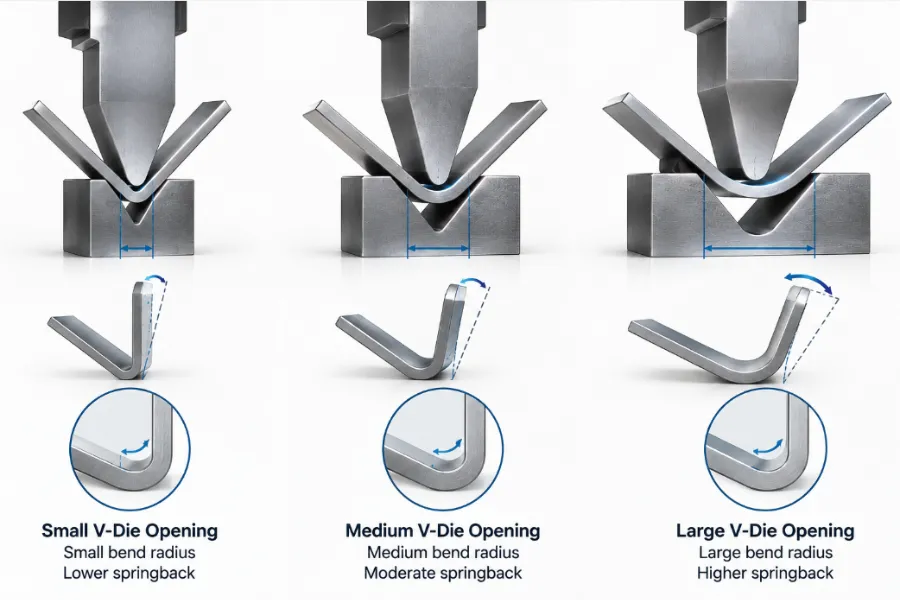
In air bending, a wider V-die opening generally produces a larger inside bend radius and therefore greater springback. The relationship between die opening and material thickness, commonly expressed as W/T, is an important tooling variable.
V-die selection also affects required force, bend radius, flange geometry, and surface contact. For this reason, reducing the opening only to reduce springback can create a different tooling or forming problem.
For more detail on selecting the opening for a specific bend, see how to choose the right V opening.
Bending Method
Air bending provides flexible angle control through punch penetration, but the final angle remains sensitive to material and tooling variation.
Bottoming brings the workpiece into closer contact with the die and can provide stronger angle control. It requires higher forming force and has different springback and springforward behavior.
Coining produces extensive plastic deformation in the bend area and can reduce springback to a very low level. The trade-off is substantially higher tonnage and greater loading on the machine and tooling.
Material Variation and Grain Direction
Two sheets with the same nominal grade and thickness can behave differently because actual thickness, yield strength, material condition, and rolling direction can vary.
For tight-tolerance work, verify the actual material and keep sheet orientation consistent where the application permits. If the same CNC program suddenly produces a different angle, material variation should be checked before assuming that the machine setting is wrong.
How to Measure Press Brake Springback
When the final angle is incorrect, measure the unloaded part before changing machine force or tooling.
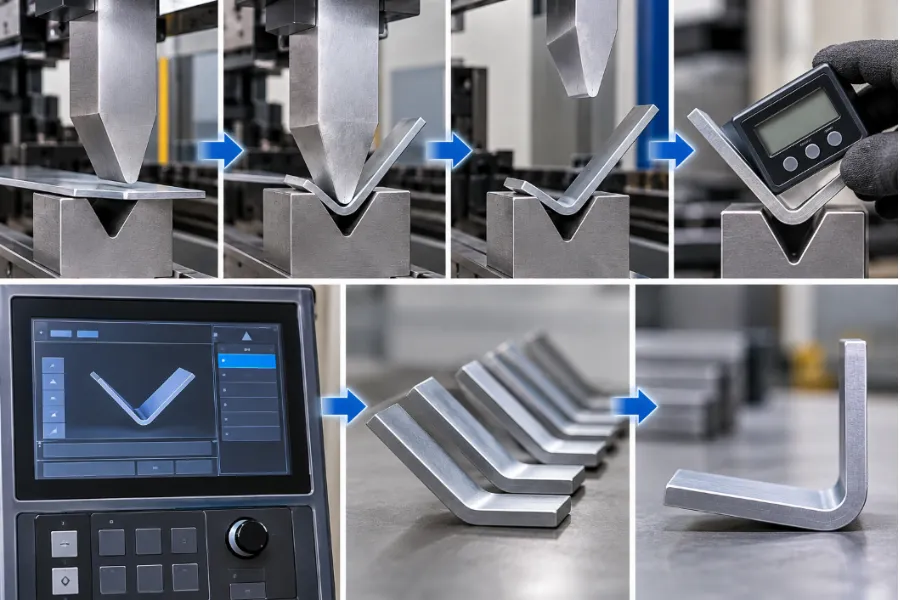
A practical test-bend sequence is:
- Use the actual production material and thickness.
- Install the intended punch and V-die.
- Make a representative test bend.
- Release the bending force completely.
- Measure the unloaded angle.
- Compare it with the required final angle.
- Apply the measured deviation as the initial compensation.
For example, if the target is 90° and the unloaded part measures 92°, the measured angular deviation is approximately 2°.
The test should represent the production geometry. A short scrap piece may not reproduce the behavior of a long workpiece because longer bends can introduce machine deflection and other length-dependent effects.
How to Calculate Press Brake Springback
For production troubleshooting, the most useful calculation is often the measured angular deviation:
Springback deviation ≈ Measured unloaded angle − Target angle
If a 90° target produces a 92° unloaded angle:
92° − 90° = 2°
This measured deviation provides a practical starting point for compensation.
Springback Factor
A springback factor can describe the relationship between the loaded bending angle and the final unloaded angle. Using the included-angle convention:
Sf = Loaded bending angle ÷ Final unloaded angle
For a bend formed to 92° that relaxes to 90°:
Sf = 92 ÷ 90 = 1.0222
The same relationship can be used to describe the change in the relaxed inside radius. For example, an initial 0.062-inch radius multiplied by 1.0222 gives approximately 0.063 inch.
This factor should not be treated as a universal material constant. Its value changes with the bending and final angles, while actual production behavior also depends on material and tooling conditions.
Theoretical calculations can provide a starting estimate, but they cannot fully represent actual thickness, yield strength, tooling, grain direction, and machine conditions. For tight tolerances, measured test-bend results should take priority.
How to Reduce and Compensate for Springback
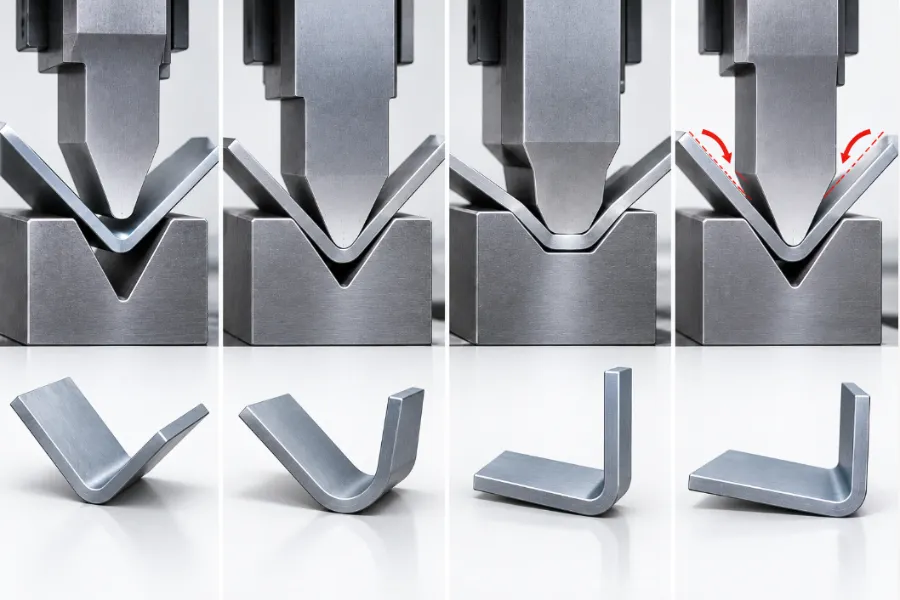
| Method | Suitable when | Main consideration |
|---|---|---|
| Overbending | General production | Requires measured compensation |
| V-die optimization | Bend radius is excessive | Must also satisfy force and geometry requirements |
| Punch radius adjustment | Tool geometry contributes to recovery | Excessively small radius can increase cracking risk |
| Bottoming | Greater angle control is required | Higher forming force |
| Coining | Very low springback is required | Very high tonnage and tooling load |
| CNC angle compensation | Repeated production | Depends on control capability |
| Automatic angle measurement | Tight tolerances or high production volume | Greater system complexity |
Use Controlled Overbending
Overbending forms the material beyond the required final geometry so that elastic recovery brings it toward the target.
Target angle → overbend → unload → measure → adjust compensation
The compensation should be based on the measured result from the actual material and tooling rather than a generic value assigned only by material grade.
Once the correction is established, a CNC control can store it in the bending program for repeat production.
Optimize Tooling
If springback is higher than expected, check the V-die opening and punch radius before increasing force.
A larger V-die opening generally increases the bend radius and springback. A smaller punch radius can increase localized plastic deformation, but it must remain compatible with material formability and cracking limits.
Consider Bottoming or Coining
Bottoming can provide stronger angle control when the machine and tooling have sufficient forming capacity.
Coining is appropriate when very low springback justifies the substantially higher force and tooling loads. It should not be treated as the default solution for ordinary air bending.
Use CNC and Angle Feedback
CNC angle compensation converts measured springback into a repeatable program correction.
For demanding applications, a CNC press brake with angle measurement and feedback capabilities can monitor the actual bend and support correction based on measured results. This becomes more valuable when material variation, production volume, or tolerance requirements make repeated manual correction inefficient.
Common Press Brake Springback Problems
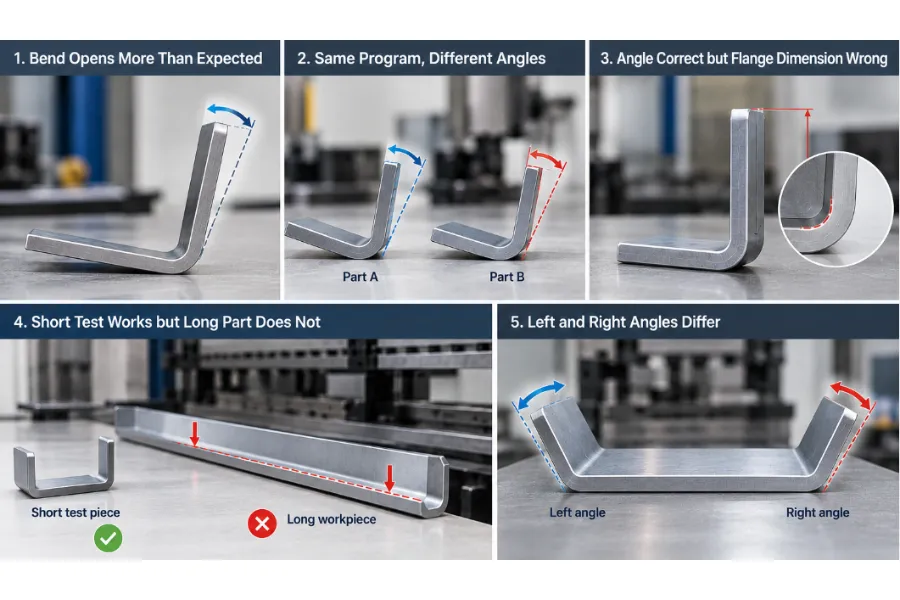
The Bend Opens More Than Expected
Check actual material thickness, material grade, bend radius, V-die opening, and compensation before increasing machine force.
The Same Program Produces Different Angles
Check material batch, actual thickness, yield-strength variation, tooling condition, alignment, and setup. If the problem extends beyond springback, use the broader press brake bending angle inconsistency troubleshooting process to determine whether the variation comes from the material, tooling, machine, or setup.
The Angle Is Correct but the Flange Dimension Is Wrong
Angle compensation will not necessarily correct a dimensional error. Actual thickness and the relaxed bend radius can change bend allowance and bend deduction.
Measure the material and bend radius, then review the flat pattern and back-gauge position. Related guidance on press brake bend allowance and bend deduction can help separate angle correction from flat-pattern correction.
A Short Test Works but a Long Part Does Not
A short test piece may not reproduce deflection behavior over the production length. For demanding parts, validate the setup using a representative workpiece length.
Left and Right Angles Differ
Uneven angles can indicate tool alignment, machine setup, crowning, load distribution, or machine-condition problems. Diagnose these factors before treating the variation as ordinary springback.
For a broader troubleshooting framework, see Common Press Brake Bending Problems.
How to Control Springback in High-Strength Steel
High-strength steel generally produces greater springback because of its higher yield strength.
Specific technical references include Hardox 450 and Strenx examples with substantial springback under defined test conditions. These values demonstrate the potential scale of the problem but should not be treated as universal values for every grade, thickness, radius, or bending direction.
For high-strength steel, evaluate:
- Material grade and actual properties
- Material thickness
- Inside bend radius
- V-die opening
- Punch radius
- Required bending force
- Tool geometry
- Target angle
- Compensation method
- Machine capacity
A representative test bend is especially important because nominal material data cannot reproduce every production condition.
Springback Control Checklist
Before production, confirm the material, thickness, target angle, inside radius, punch, V-die, bending method, machine capacity, and production length.
During setup, perform a representative test bend, measure the unloaded angle, apply compensation, and verify the resulting radius and dimensions.
During production, monitor angle variation and recheck compensation when the material batch or other forming conditions change.
For BENDORA press brake applications, machine selection should consider material, thickness, bending length, required accuracy, production volume, tooling, and other application conditions. Providing these parameters allows the required bending capacity and configuration to be evaluated more accurately.
FAQ
What causes springback in press brake bending?
Springback is caused by elastic recovery after the bending force is released. Material strength, R/T ratio, V-die opening, bending method, tooling, and material variation affect its magnitude.
How do you compensate for press brake springback?
Perform a test bend with the actual material, measure the unloaded angle, calculate the deviation from the target, and apply controlled overbending or CNC angle compensation.
Does a larger V-die opening increase springback?
Generally, yes. A larger V-die opening usually produces a larger bend radius in air bending, increasing the tendency for elastic recovery.
Does stainless steel have more springback than mild steel?
Generally, stainless steel tends to show more springback under comparable conditions, but the actual result depends on grade, thickness, radius, tooling, and bending method.
Can coining eliminate springback?
Coining can reduce springback to a very low level through substantial plastic deformation, but it requires significantly higher tonnage and greater tooling loads than air bending.