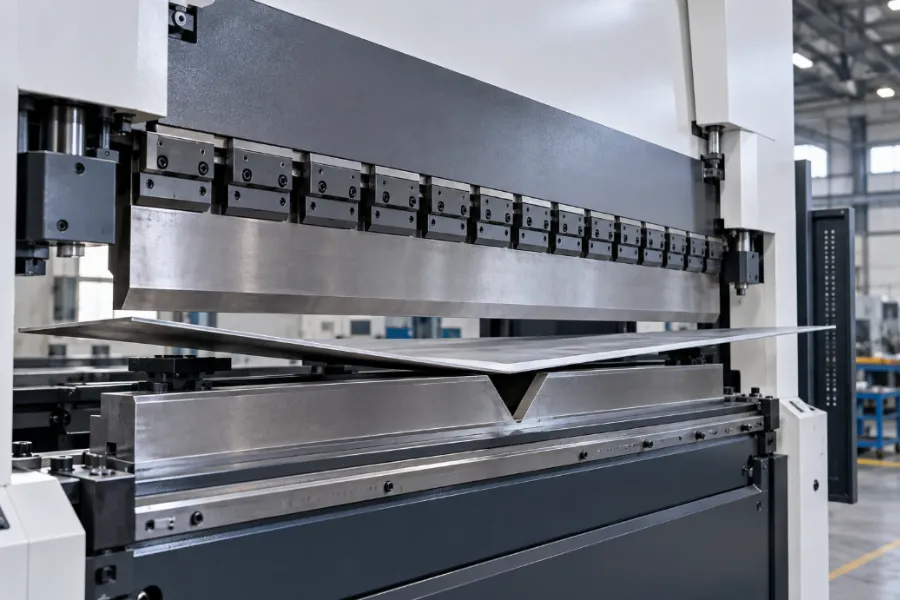
Press brake crowning is a deflection compensation method used to maintain a more consistent bend angle across the length of a workpiece. It counteracts elastic deformation in the press brake structure when bending force is applied.
This becomes important when deflection changes the relative position of the punch and die along a long bend. Without sufficient compensation, the center and ends of the workpiece may form at different angles even though they are produced in the same bending operation.
Crowning addresses machine deflection under load. It does not automatically correct springback, worn tooling, poor machine leveling, material variation, or ram synchronization problems.
What Is Press Brake Crowning?
A press brake is not perfectly rigid. When bending force is applied, the ram, bed, and frame carry opposing loads and deform elastically.
Crowning creates a controlled compensation profile along the press brake table or die-supporting system. This counteracts load-induced deflection so the punch and die maintain a more consistent relative geometry across the bending length.
The relationship can be summarized as:
Bending load → machine deflection → variation in punch-to-die geometry → bend angle variation
Crowning introduces counter-deflection to reduce this variation.
Why Is Press Brake Crowning Needed?
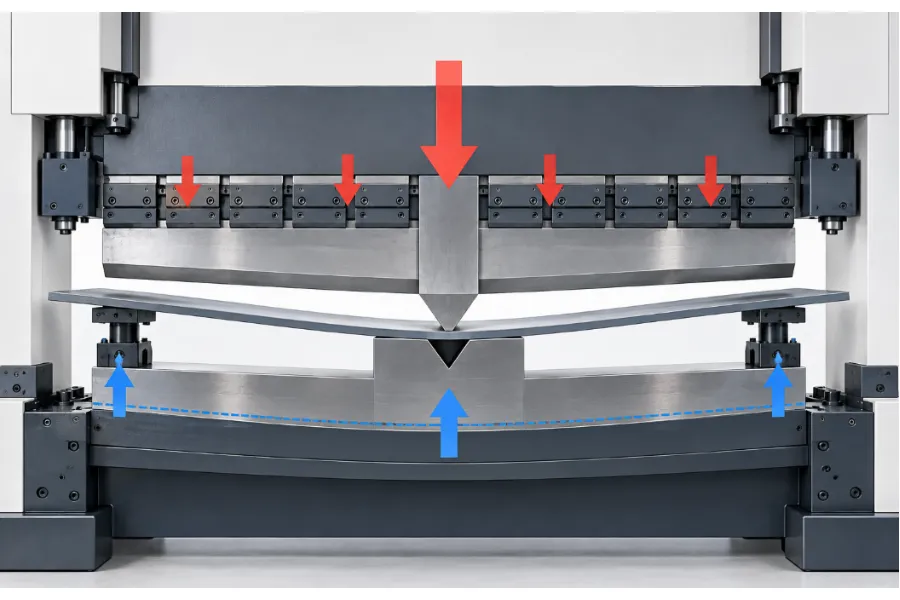
Bend accuracy depends on both the programmed ram position and the geometry the machine maintains while carrying the bending load.
If the structure deflects, the effective tooling relationship can vary from the ends toward the center. Particularly in air bending, changes in effective punch penetration can then produce different bend angles along the same part.
How Bending Conditions Affect Deflection
Deflection is not determined by workpiece length alone. It is influenced by the bending load, load distribution, working length, machine stiffness, material, sheet thickness, and tooling conditions such as the V-die opening.
Changing one variable can affect another. For example, changing the die opening changes the force required for a given bending operation, which can change machine deflection and therefore the compensation required.
This is why one crowning setting should not be assumed to work for every job.
Why Long Bends Reveal the Problem
A short workpiece uses only part of the available working length and may not expose the full longitudinal deflection pattern.
A long part spans more of the machine. Differences between the center and ends therefore become easier to detect, especially when the bending load is high or the part requires tight angular consistency.
What Happens When Crowning Is Incorrect?
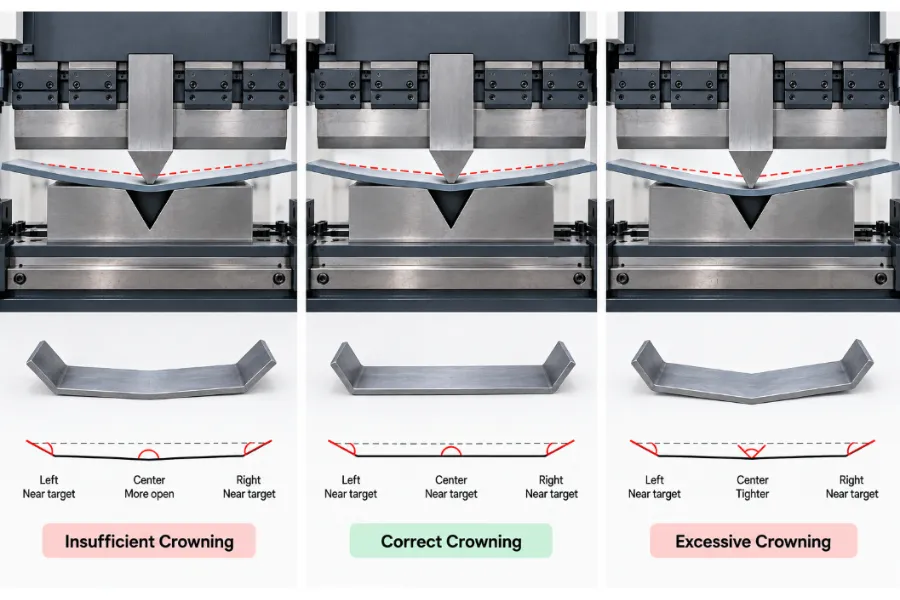
The important symptom is usually not simply an incorrect angle. It is a change in angle along the bending length.
A representative undercompensation pattern may look like this:
| Position | Bend Result |
|---|---|
| Left | Near target |
| Center | More open |
| Right | Near target |
If the center remains more open than both ends, insufficient compensation or excessive machine deflection should be investigated. If the center becomes tighter than both ends after compensation is increased, overcompensation may be contributing.
The objective is therefore not to maximize crowning. It is to match the compensation profile to the deflection produced by the actual bending condition.
How Does a Press Brake Crowning System Work?
A crowning system modifies the longitudinal profile of the table or die-supporting system to oppose deformation under load.
In simplified terms:
Load-induced deflection + controlled counter-deflection = more uniform tooling geometry under load
The required compensation depends on the machine and bending conditions. On CNC press brakes, the control system may calculate an initial compensation value from programmed parameters and command the crowning mechanism accordingly.
The resulting setting should still be verified when conditions change significantly. Material, thickness, bending length, tooling, V-die opening, and required bending force can all influence the result.
Mechanical vs. Hydraulic Press Brake Crowning
Mechanical and hydraulic crowning use different methods to create counter-deflection. Their actual performance depends on the machine design, control architecture, maintenance condition, and how well the compensation matches the bending load.
Mechanical Crowning
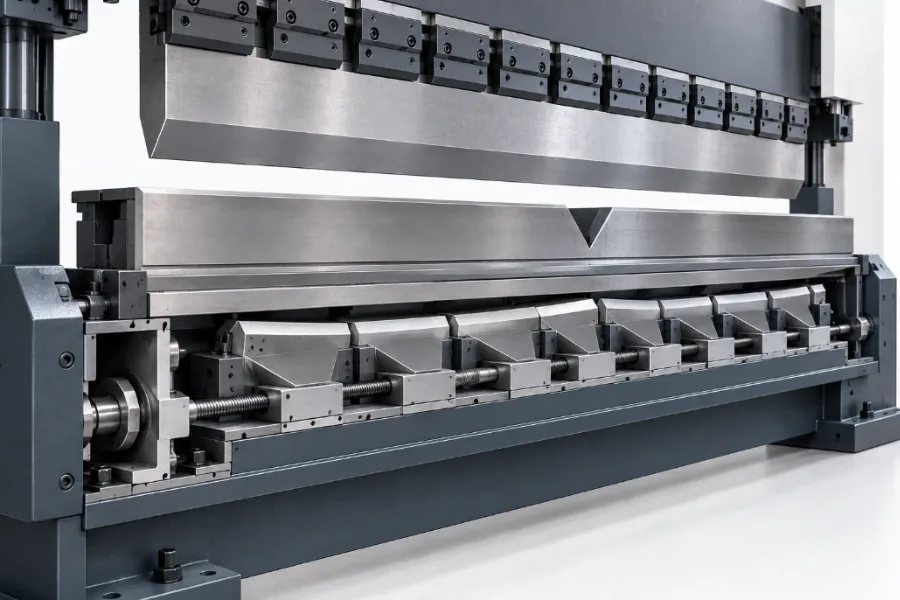
Mechanical crowning commonly uses multiple wedge-shaped elements positioned along the press brake table. Relative movement between the wedges changes the vertical profile of the die-supporting surface.
Depending on the design, adjustment may be manual or CNC-controlled. In a CNC system, a motorized mechanism positions the wedges according to the required compensation setting.
Mechanical crowning avoids hydraulic leakage within the crowning mechanism. However, wedges, screws, drive components, alignment, and lubrication can affect performance as the system wears.
Hydraulic Crowning
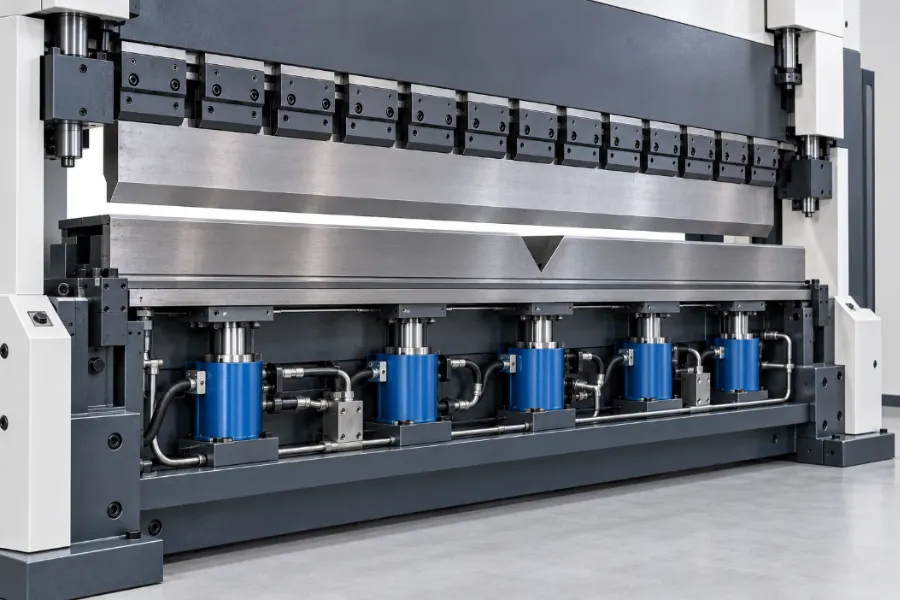
Hydraulic crowning uses hydraulic cylinders integrated into or beneath the table to generate controlled counter-deflection.
The hydraulic and control systems regulate the compensation according to the machine design and bending conditions. Unlike a wedge system, the required profile is generated through controlled hydraulic action and elastic deformation of the table.
Hydraulic crowning avoids wear associated specifically with sliding crowning wedges, but its performance depends on hydraulic condition. Seals, valves, connections, pressure control, and leakage are therefore relevant maintenance factors.
| Factor | Mechanical Crowning | Hydraulic Crowning |
|---|---|---|
| Compensation method | Adjustable wedge system | Hydraulic actuation |
| Control | Manual or CNC, depending on design | Hydraulic/CNC control |
| Profile generation | Wedge geometry and movement | Cylinder arrangement and controlled force |
| Hydraulic leakage risk | None within crowning mechanism | Possible |
| Main wear or service concern | Wedges and drive components | Seals and hydraulic components |
| Maintenance focus | Wear, alignment, lubrication | Pressure, valves, seals, leakage |
These differences do not establish a universal winner. Machine structure, required accuracy, working length, bending conditions, control system, and maintenance requirements should be considered together.
Crowning vs. Springback
Crowning and springback can both appear as bend-angle errors, but they come from different mechanisms.
Machine deflection occurs in the press brake structure while bending force is applied. Springback is the elastic recovery of the workpiece after the load is removed.
The spatial pattern of the error provides a useful diagnostic clue. If a long part is too open by a similar amount across its full length, investigate bend depth, material behavior, springback, and other process settings before assuming the crowning value is too low.
If both ends are close to the target but the center consistently differs, machine deflection and crowning become stronger candidates.
The two effects can also occur together. For that reason, angle error alone is not enough to identify the cause.
How to Diagnose a Crowning Problem
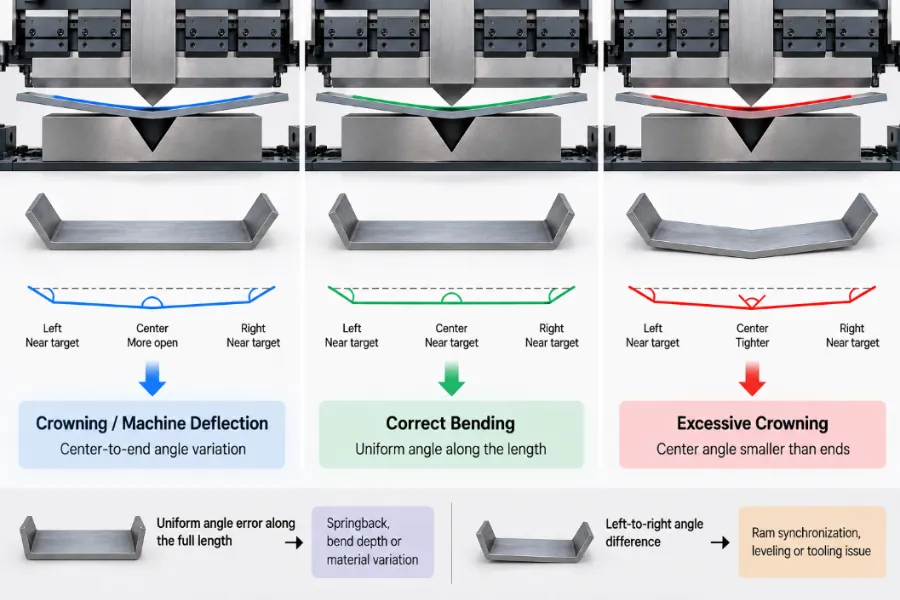
Before changing the compensation value, measure the bend at multiple positions. For a long workpiece, left, center, and right measurements provide a basic picture of how the error is distributed.
| Observed Pattern | What to Investigate |
|---|---|
| Center more open than both ends | Insufficient crowning or machine deflection |
| Center tighter than both ends | Excessive crowning may be contributing |
| Similar error across the full length | Bend depth, springback, material, or process settings |
| Significant left-to-right difference | Ram parallelism, Y1/Y2 synchronization, machine level, or tooling |
| Irregular local variation | Tool wear, clamping, seating, or material variation |
| Short parts are accurate but long parts are not | Deflection and crowning |
These are troubleshooting indicators, not absolute rules. More than one source of error can exist in the same bending operation.
What Should You Check Before Adjusting Crowning?
Increasing compensation whenever an angle error appears can hide the actual cause. Check the variables that can produce similar symptoms first.
Tooling Condition and Clamping
Worn punch radii and die shoulders alter the contact geometry during bending. Poorly seated or incorrectly clamped tooling can also create local angle differences that crowning cannot correct.
Inspect the punch, die, clamping surfaces, and tooling position before making large compensation changes.
Machine Level and Ram Synchronization
Machine level and ram parallelism can affect angle consistency across the working length. On machines with independently controlled ram axes, Y1/Y2 synchronization is another factor when the two sides behave differently.
A primarily left-to-right error therefore points toward a different diagnostic path than a symmetrical center-to-end error.
Material Variation
Material properties affect bending force and springback. Thickness variation, mechanical properties, and grain direction can therefore change the bending result even when the CNC program remains unchanged.
Crowning can compensate for machine deflection, but it cannot make inconsistent material behave identically.
Bending Length
A short test coupon may bend correctly while a production-length part develops a center-to-end angle difference.
When investigating crowning, use a test piece representative of the actual bending length whenever practical. Otherwise, the test may not reproduce the load distribution and deflection pattern causing the production problem.
How to Set and Verify Press Brake Crowning
Start with the calculated or programmed compensation appropriate for the bending condition. Make a representative test bend, then measure the angle at the left, center, and right.
If the center remains more open than both ends, increase compensation in controlled increments and repeat the measurement. If the center becomes tighter than the ends, the adjustment may have passed the required compensation level.
Avoid making large changes based on one measurement. Comparing the angle distribution before and after each adjustment helps determine whether crowning is actually correcting the observed error.
For repeat jobs, record the successful combination of material, thickness, bending length, tooling, and compensation setting. Recheck the result after significant changes to the material or bending setup rather than assuming the previous crowning value remains valid.
What Should You Consider When Selecting a Crowning System?
Crowning should be evaluated as part of the complete press brake system rather than as an isolated feature.
Consider the expected bending length, material and thickness range, tooling, required bending force, angular accuracy, production mix, control system, and maintenance requirements. These variables determine both how significant deflection becomes and how the compensation system will be used in production.
When comparing press brakes, ask how deflection compensation is generated and controlled, whether adjustments are manual or CNC-controlled, and how operators can verify or fine-tune compensation when bending conditions change.
The useful question is not simply whether a press brake has crowning. It is whether the machine, tooling, control strategy, and crowning system work together for the parts you need to produce.
FAQ
Does every press brake need crowning?
The need depends on machine design, bending load, working length, tooling, and required accuracy. Crowning becomes particularly relevant when machine deflection creates measurable angle differences along long workpieces.
What is the difference between mechanical and hydraulic crowning?
Mechanical crowning typically uses adjustable wedges to modify the table profile. Hydraulic crowning uses controlled hydraulic action to generate counter-deflection. Performance depends on the specific machine and system design rather than the compensation method alone.
Can press brake crowning correct springback?
Crowning primarily compensates for machine deflection under load. Springback is elastic recovery of the material after unloading, so it requires consideration of material behavior and bending parameters rather than crowning alone.
How do you know if press brake crowning needs adjustment?
Measure a representative long bend at the left, center, and right. A consistent center-to-end angle difference can indicate a crowning or deflection issue, while uniform, left-to-right, or irregular errors point toward other variables that should also be checked.