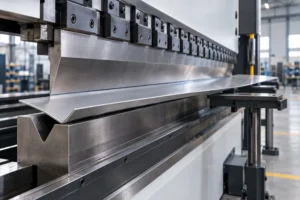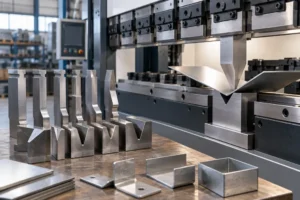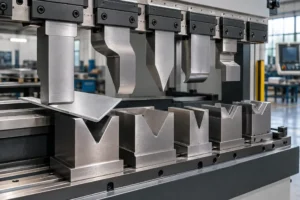
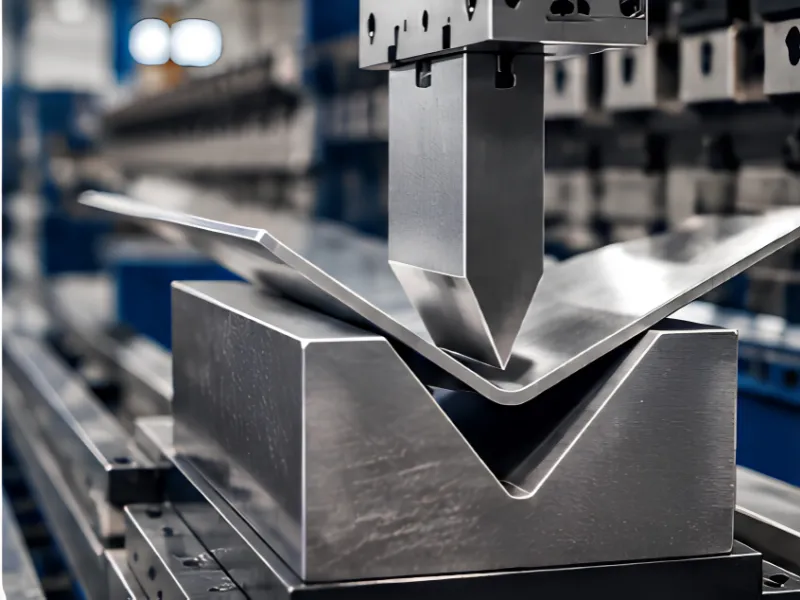
Calculating press brake tonnage starts with four main variables: material thickness, bend length, tensile strength, and V-die opening. Together, they determine the bending force required to form a part.
The most important relationship to remember is:
Required Force ∝ Bend Length × Thickness² × Tensile Strength ÷ V-Die Opening
This explains why a small change in thickness or tooling can produce a large change in required force. If material thickness doubles while other conditions remain unchanged, the required tonnage increases by approximately four times.
The calculation is only the starting point. Before bending, you should also verify the bending method, tooling load rating, loaded length, and machine limits.
What is Press Brake Tonnage?
Press brake tonnage is the force required to bend sheet metal between a punch and die. Depending on the machine and reference chart, it may be expressed in metric tons, U.S. tons, kilonewtons, tons per meter, or tons per foot.
Correct tonnage affects bend quality, tooling selection, machine capacity, and operating safety. Insufficient force may prevent the intended bend, while excessive or concentrated force can overload the tooling or machine.
This is why the correct question is not simply how much total tonnage a press brake has, but how much force the specific bending operation requires and where that force is applied.
Press Brake Tonnage Calculation Formula
The engineering relationship for V-bending can be expressed as:
P ∝ L × t² × σb / V
Where:
- P = required bending force
- L = bend length
- t = material thickness
- σb = tensile strength
- V = V-die opening width
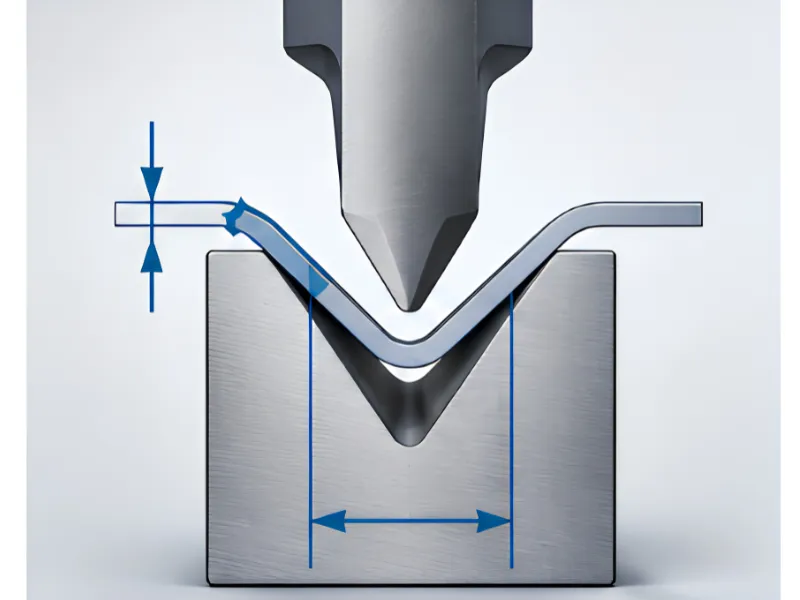
The exact constant depends on the units, reference material, tooling, and bending method used by a particular formula or tonnage chart. For this reason, formulas from different references should not be mixed without checking their assumptions.
For SS material under the specified reference conditions in the tooling data, required force per meter can also be estimated with:
P = 68 × t² / V
Here, t and V are in millimeters. The value 68 incorporates the material strength and correction assumptions of that reference, so it is not a universal constant for every material or bending process.
For another material, use its actual tensile strength to correct the reference value whenever reliable material data is available.
What Changes the Required Bending Force?
Four relationships explain most press brake tonnage calculations.
Thickness has a squared effect. If thickness doubles while the other variables remain unchanged, the required force increases by approximately four times.
Bend length has a linear effect. Doubling the loaded bending length approximately doubles the total required force.
V-die opening has an inverse effect. A narrower V opening requires more force, while a wider opening reduces the required tonnage under otherwise comparable conditions.
Tensile strength has a linear effect. Stronger material requires more force to form than weaker material of the same dimensions.
In practical terms:
Longer + Thicker + Stronger + Narrower V = More Tonnage
Thickness deserves particular attention because it is squared rather than simply multiplied once.
Choose the V-Die Opening Before Calculating Tonnage
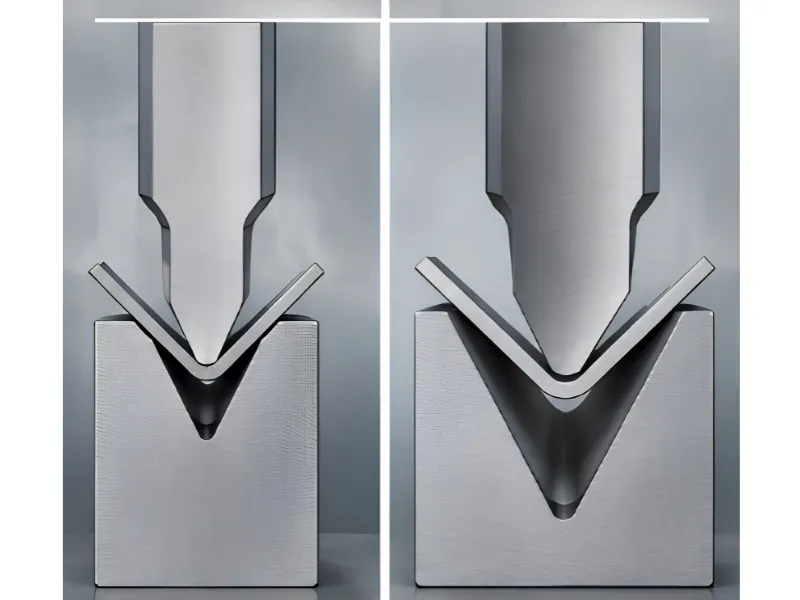
V-die opening is part of the force calculation, so it should be established before the final tonnage is calculated.
The reference tooling guidance provides the following starting points for its specified bending conditions:
| Bending Condition | Reference V Opening |
|---|---|
| Bottom bending, 0.5–2.6 mm | About 6 × t |
| Bottom bending, 3.0–8.0 mm | About 8 × t |
| Bottom bending, 9.0–10.0 mm | About 10 × t |
| Partial or free bending | About 12–15 × t |
| Coining | About 5–6 × t |
These ratios come from the referenced tooling guidance and should not be treated as universal V-die rules for every modern press brake application. The appropriate opening also depends on material properties, bending method, desired inside radius, minimum flange, and available tooling.
The same reference gives an approximate inside radius of V/6 and a minimum flange length of about 0.7V under the applicable conditions.
A smaller V opening can help meet certain bend geometry requirements, but it also increases bending force. Die selection therefore affects both part geometry and machine capacity.
How to Calculate Press Brake Tonnage Step by Step
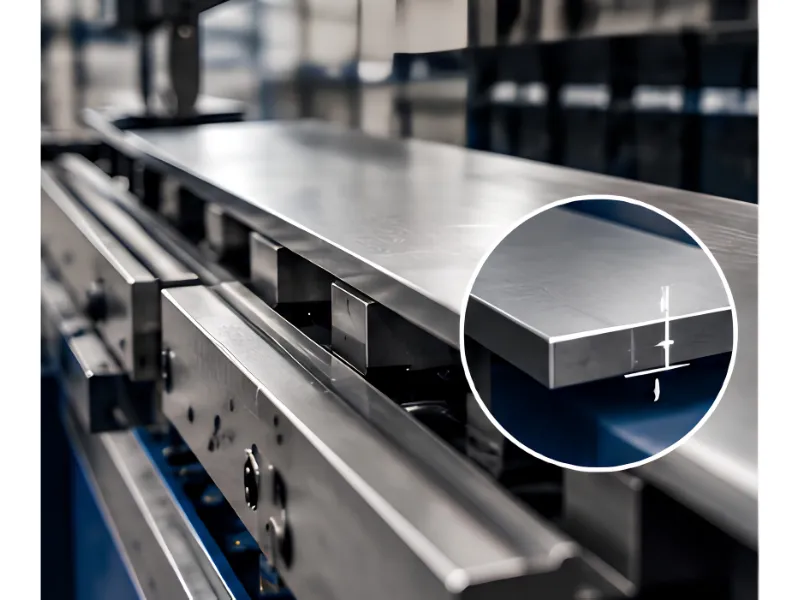
Consider the following reference example:
- Material: stainless steel
- Thickness: 1.5 mm
- Bend length: 2 m
- Tensile strength: 60 kgf/mm²
- Reference tensile strength: 45 kgf/mm²
Step 1 — Determine the V-Die Opening
For the bending condition used in this reference example:
6 × 1.5 = 9 mm
Because a 9 mm opening is not available in the referenced standard tooling sizes, the next larger opening is selected:
V = 10 mm
Step 2 — Find the Reference Tonnage
The exact thickness of 1.5 mm is not included in the reference tonnage chart, so the nearest listed value of 1.6 mm is used.
The corresponding chart value is:
17 tons per meter
This is the baseline rather than the final answer.
Step 3 — Correct for Actual Thickness
Required force changes with thickness squared, so the correction is:
17 × (1.5 / 1.6)²
Using only a simple 1.5/1.6 ratio would underestimate the effect of thickness.
Step 4 — Correct for Tensile Strength
The actual tensile strength is 60 kgf/mm² compared with the 45 kgf/mm² reference:
60 / 45 = 1.33
Step 5 — Apply the Bend Length
The complete calculation is:
17 × (1.5 / 1.6)² × (60 / 45) × 2 ≈ 40 tons
The estimated required force is therefore approximately 40 tons under these stated reference conditions.
This example also shows why a tonnage chart should not be used by reading thickness alone. Material strength, V opening, and actual bend length all affect the result.
How Material Strength Affects Press Brake Tonnage
When a tonnage chart uses a reference material, another material can be corrected using the ratio of tensile strengths:
Material Factor = Actual Tensile Strength / Reference Tensile Strength
For example:
60 / 45 = 1.33
Under otherwise identical conditions, the material with a tensile strength of 60 kgf/mm² requires approximately 1.33 times the reference force.
This is more reliable than assuming that every stainless steel needs the same fixed multiplier or every aluminum alloy requires the same reduction.
Material grades and conditions vary. When possible, use the actual tensile strength from the material specification or mill certificate.
Air Bending, Bottom Bending, and Coining Need Different Force
The bending method must match the assumptions behind the formula or tonnage chart.
In air bending, the sheet contacts the punch tip and the two die shoulders without being fully pressed against the die surfaces. This generally requires less force.
Bottom bending drives the material further into the tooling and can require substantially greater force. Coining uses still higher pressure to plastically compress the material around the bend.
The exact difference depends on the process and tooling, so a universal multiplier should not be applied blindly.
This distinction is especially important when comparing reference sources. Some traditional tonnage charts are based on specified bottom-bending conditions, while many modern press brake calculators use air bending as their baseline.
Always identify the bending method before applying a formula.
Total Tonnage vs. Tonnage per Meter
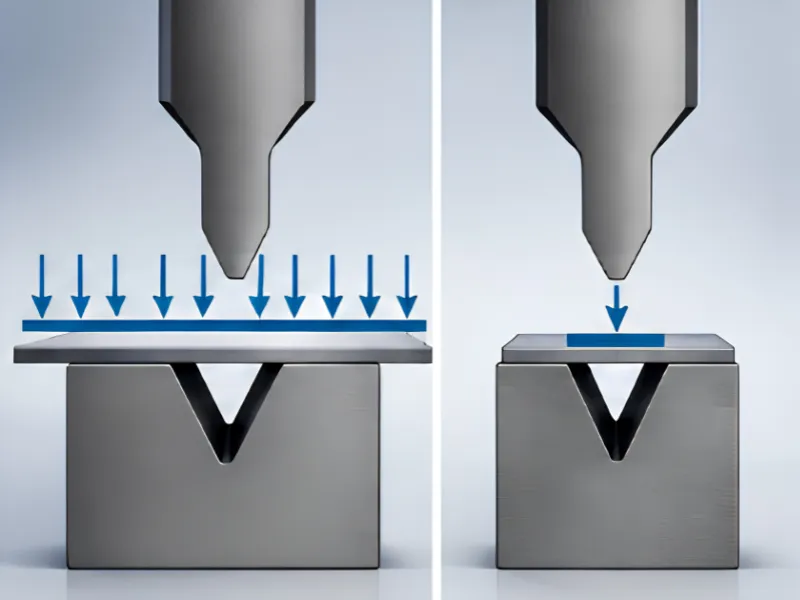
Total machine tonnage is only one load limit.
Suppose a job requires 40 tons. Applying that force over a 2-meter bend creates a very different loading condition from concentrating the same force over a short section of tooling.
Press brake tooling may therefore carry a maximum line-load marking such as:
MAX 1000 kN/m
Using the approximate conversion:
1 kN ≈ 0.102 metric ton-force
1000 kN/m corresponds to roughly 100 metric tons per meter.
The machine may have enough total tonnage while the selected tooling cannot safely carry the concentrated load. Total machine capacity and tooling load per unit length should therefore be checked separately.
Check the Tooling and Machine Load Limits
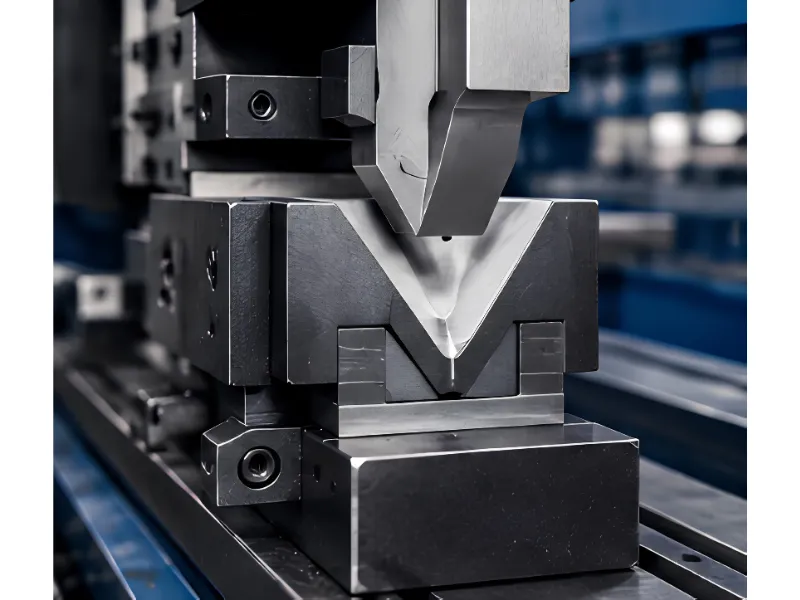
Once you calculate the required bending force, verify the result against both the tooling and press brake.
Start with the punch and die. Tooling manufacturers may mark allowable loads in kN/m, tons/m, or tons/ft. Different tool profiles can have very different load capacities, so never assume that all punches with the same length can withstand the same force.
Next, verify the machine. A press brake‘s rated tonnage does not necessarily mean its full force can be applied at every position or over every loaded length.
Machine construction, load distribution, working length, and manufacturer-specified centerline or local load limits can affect allowable capacity. Higher bending loads over long working lengths can also make machine deflection more significant, which is why press brake crowning may be used to compensate for angle variation along the bend.
If the calculated force approaches any stated machine or tooling limit, use the manufacturer’s documentation rather than relying on the theoretical tonnage calculation alone.
Common Press Brake Tonnage Calculation Mistakes
Several mistakes can make an otherwise simple calculation unreliable.
Treating thickness as a linear variable. Required force changes approximately with thickness squared, not thickness alone.
Ignoring tensile strength. Material name alone does not provide enough information when grades and conditions vary.
Changing the V die after calculating. Because V is part of the equation, changing the opening changes the required tonnage.
Mixing bending methods. An air-bending formula should not automatically be applied to bottom bending or coining.
Using machine bed length instead of actual bend length. Calculate force from the length of material engaged in the bend.
Checking only total machine tonnage. The punch, die, and machine must all withstand the actual load distribution.
Mixing units. Confirm whether your references use kN, metric tons, U.S. tons, tons/m, or tons/ft before comparing values.
What Tonnage Press Brake Do I Need?
Start with the most demanding bend you expect the machine to produce rather than an average job.
Identify:
- Material and tensile strength
- Maximum thickness
- Maximum bend length
- Required bend geometry
- V-die opening
- Bending method
- Tooling requirements
- Production conditions
Calculate the required bending force, then verify that the proposed machine and tooling can safely handle that force over the actual loaded length. You can use our press brake tonnage calculator to estimate the required bending force based on material, sheet thickness, bend length, and V-die opening.
More tonnage is not automatically better. Oversizing a press brake can increase machine size and investment without solving problems related to tooling, bend geometry, accuracy, or production requirements.
For machine selection, the useful question is therefore not simply “How many tons do I need?” It is “What force does my most demanding bending application require, and under what conditions?”
Frequently Asked Questions
How do you calculate press brake tonnage?
Identify the material thickness, bend length, tensile strength, V-die opening, and bending method. Required force increases with bend length, tensile strength, and the square of thickness, while a wider V opening generally reduces the force required.
Does doubling material thickness double the tonnage?
No. Under otherwise identical conditions, bending force is approximately proportional to thickness squared. Doubling thickness can therefore increase the required force by approximately four times.
Does a larger V die reduce bending force?
Generally, yes. A wider V opening reduces required tonnage under comparable conditions. However, it also affects the achievable inside radius and minimum flange, so V-die selection should consider part geometry as well as force.
Does stainless steel always require 1.5 times the tonnage of mild steel?
No. Different grades have different tensile strengths. Using the actual tensile-strength ratio provides a better correction than applying one universal stainless-steel multiplier.
Can I select a press brake from calculated tonnage alone?
No. You should also verify tooling load ratings, actual loaded length, machine load-distribution limits, bending method, and the production range the machine must handle.
Calculate the Force, Then Verify the Application
Press brake tonnage calculation is based on a straightforward relationship: force increases with bend length, tensile strength, and especially material thickness, while increasing the V-die opening reduces the required force.
The calculated value still needs to be checked against the actual bending method, punch and die ratings, loaded length, and press brake limits.
When evaluating a BENDORA press brake, provide the material, thickness, maximum bend length, part drawing, bend geometry, and production requirements. This allows the machine and tooling configuration to be evaluated around the actual bending application rather than a single tonnage number.