Top 10 Sheet Metal Bending Machine Manufacturers
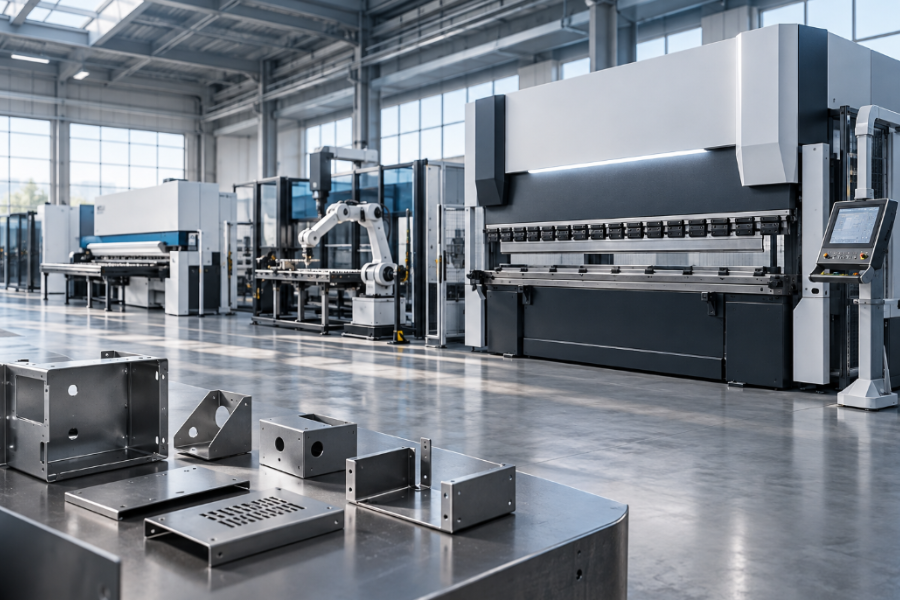
Table of Contents
Sheet metal bending machine manufacturers differ in forming method, tooling, process control, workpiece handling, and automation — not only in tonnage, working length, or machine price. This guide compares industrial press brakes, panel benders, and folding systems to help buyers match bending technology to part and production requirements.
Sheet Metal Bending Machine Manufacturers at a Glance
| Manufacturer | Country | Main Bending Approach | Technical Focus | Suitable Production |
|---|---|---|---|---|
| TRUMPF | Germany | Press brake, automated and panel bending | Connected bending ecosystem | Automated and digitally integrated fabrication |
| AMADA | Japan | Press brake | Tooling and setup automation | High-mix production with frequent changeovers |
| Salvagnini | Italy | Panel bending | Flexible automatic panel bending | Multi-edge panels and flexible automated production |
| Bystronic | Switzerland | CNC press brake | Modular CNC bending and automation | Production scaling from standalone bending to automated cells |
| Prima Power | Italy/Finland | Panel bender, press brake | Servo-electric and flexible automation | Mixed production using different bending approaches |
| LVD | Belgium | Press brake | Adaptive bending and angle correction | Bending affected by material variation |
| Durma | Türkiye | Press brake, bending center | Broad bending architecture range | Production requiring different drive or automation configurations |
| SafanDarley | Netherlands | Press brake | Servo-electronic bending | Production evaluating full-electric press brake technology |
| CIDAN Machinery | Sweden | Folding machine | Folding-beam technology | Long sheets, panels, and folding applications |
| BENDORA | China | Press brake | Application-driven configuration | Workpiece-specific press brake configuration |
How We Selected These Manufacturers
The selection considers bending product depth, engineering differentiation, application coverage, automation capability, technical documentation, and documented participation in industrial sheet metal processing.
The list includes different forming approaches rather than 10 similar hydraulic press brake manufacturers. Press brakes, panel benders, servo-electric machines, automated bending cells, and folding systems are represented because part geometry, handling requirements, and production volume can favor different machine architectures.
The numerical order organizes the comparison and does not represent a ranking by market share, machine quality, company size, or overall technical capability.
1. TRUMPF

Founded: 1923
Headquarters: Ditzingen, Germany
Website: trumpf.com
Specialization: Connected and automated sheet metal manufacturing
Main Products: Press brakes, automated bending cells, panel bending systems, bending tooling, software, and other sheet metal processing equipment
TRUMPF’s bending portfolio extends from standalone TruBend press brakes to automated bending cells and panel bending. The TruBend Cell 7000, for example, combines automated workpiece handling, ToolMaster Bend automatic tool setup, LoadMaster Bend loading, and ACB angle measurement.
TRUMPF also connects bending equipment with programming and production software. This makes the portfolio relevant when tool setup, material handling, forming, angle control, and production data need to operate as a coordinated process rather than as separate workstation functions.
Why Does TRUMPF Stand Out?
Multiple automation levels: Buyers can evaluate standalone bending, automated press brake cells, and panel bending within the same manufacturing ecosystem.
Integrated process functions: Automatic tooling, part handling, angle measurement, and software address multiple stages of the bending workflow.
Suitable For: Fabricators planning automated or digitally integrated sheet metal production.
2. AMADA

Founded: 1946
Headquarters: Kanagawa, Japan
Website: amada.com
Specialization: Sheet metal processing systems with integrated tooling and setup automation
Main Products: Electric and hydraulic press brakes, automatic tool changing systems, robotic bending systems, and tooling
AMADA is particularly relevant where setup time accounts for a significant share of the bending cycle. Its bending portfolio includes electric and hydraulic press brakes with Automatic Tool Changers (ATC), as well as robotic bending systems.
The EGB 1303 ARs combines a servo-electric press brake, six-axis robot, automatic gripper changer, ATC, angle sensing, and AMADA tooling. In high-mix production, these functions target non-bending time created by frequent part, tool, and gripper changes.
Why Does AMADA Stand Out?
Tooling-system integration: AMADA combines press brake technology with tooling and automatic setup rather than treating tooling as an independent accessory.
Changeover automation: Automatic tool and gripper changes directly target setup time between different parts.
Suitable For: High-mix sheet metal production where tooling and part changeovers are recurring production constraints.
3. Salvagnini

Founded: 1963
Headquarters: Sarego, Italy
Website: salvagninigroup.com
Specialization: Flexible sheet metal processing and automatic panel bending
Main Products: Panel benders, press brakes, robotic panel bending, laser systems, and integrated manufacturing solutions
Salvagnini’s P4 uses panel-bending architecture rather than conventional punch-and-die press brake operation. Universal bending tools accommodate different panel geometries during automated bending, while automatic manipulation reduces repeated manual repositioning of multi-edge parts.
MAC3.0 detects differences between nominal and actual material characteristics and adjusts movements of the bending unit and manipulator. P-Robot extends the process with robotic loading and handling.
Why Does Salvagnini Stand Out?
Flexible panel bending: Automatic handling and universal tooling reduce repeated workpiece manipulation in multi-edge panel forming.
In-cycle adaptation: Material variation can be compensated during bending instead of relying only on nominal material data.
Suitable For: Multi-edge panel parts where automatic handling and reduced retooling can remove production bottlenecks.
4. Bystronic

Founded: 1964
Headquarters: Niederönz, Switzerland
Website: bystronic.com
Specialization: Modular CNC bending and sheet metal automation
Main Products: CNC press brakes, automated bending cells, laser cutting systems, software, and automation
Bystronic’s Xpert Pro uses a modular approach that allows press brake configuration to be matched to different production requirements and adapted as those requirements change.
ByCell Bend extends this approach into robotic bending. Depending on configuration, these cells combine robotic handling, offline programming, automatic tooling or gripper management, and laser angle measurement. Dynamic crowning compensates for machine deflection during bending.
Why Does Bystronic Stand Out?
Modular configuration: Machine and automation options can be matched to bending capacity, batch size, and changing production requirements.
Scalable automation: Buyers can move from configurable CNC press brakes toward automated bending cells within the same portfolio.
Suitable For: Fabricators that need CNC bending with a potential path toward greater automation.
5. Prima Power

Founded: 1977
Headquarters: Collegno, Italy
Website: primapower.com
Specialization: Flexible sheet metal manufacturing and servo-electric technology
Main Products: Panel benders, servo-electric and hydraulic press brakes, and robotic bending cells
Prima Power covers several bending architectures: servo-electric panel benders, eP servo-electric press brakes, hP hydraulic press brakes, and robotic cells integrating panel benders or press brakes. This allows different part families to be evaluated against different forming and automation methods.
Why Does Prima Power Stand Out?
Servo-electric forming: Electric servo drives are used across important parts of its bending portfolio rather than appearing as a single niche machine.
Flexible automation: Panel benders, press brakes, and robotic cells address different combinations of part geometry, handling, and production flow.
Suitable For: Flexible manufacturing environments that require different bending approaches for different part families.
6. LVD

Founded: 1952
Headquarters: Gullegem, Belgium
Website: lvdgroup.com
Specialization: Adaptive bending, CNC forming, and integrated sheet metal production
Main Products: Hydraulic and electric press brakes, automatic tool-changing press brakes, robotic bending systems, and custom solutions
LVD’s Easy-Form Laser measures the bend during forming and sends the measurement to the CNC, which can correct punch position without interrupting the bending process.
This addresses variation that programmed values alone cannot eliminate. Springback, strain hardening, and grain direction can change the resulting angle. LVD’s ToolCell combines this adaptive control with automatic tool changing and integrated tooling storage, linking angle correction and setup automation within one bending system.
Why Does LVD Stand Out?
Real-time correction: Bend measurement feeds directly into CNC correction during forming.
Adaptive system integration: Angle correction, tooling storage, automatic tool changes, and multi-axis positioning can operate within the same process.
Suitable For: Production where material variation makes consistent bend angles difficult to maintain.
7. Durma

Founded: 1956
Headquarters: Bursa, Türkiye
Website: durmazlar.com.tr
Specialization: Multiple press brake architectures and automated sheet metal bending
Main Products: Hydraulic, servo-assisted and electric press brakes, plus automatic bending centers
Durma’s portfolio includes AD-S and PBF hydraulic press brakes, AD-SERVO machines, AD-ES and AD-EB electric press brakes, and the PB Bending Center.
AD-SERVO uses a servo-controlled hydraulic architecture, while AD-ES uses an electric drive without hydraulic oil as its drive system. The PB Bending Center extends the range into fully automatic bending and tool changing.
Why Does Durma Stand Out?
Architecture breadth: Hydraulic, servo-assisted, electric, and automatic bending-center configurations provide different approaches to drive technology and production flow.
Automation range: Buyers can compare conventional press brake operation with a more automated bending-center workflow within one manufacturer portfolio.
Suitable For: Production teams comparing drive and automation architectures before selecting a bending system.
8. SafanDarley

Website: safandarley.com
Specialization: Servo-electronic and hydraulic press brake technology
Main Products: E-Brake servo-electronic press brakes, hydraulic and hybrid press brakes, and bending automation
SafanDarley’s E-Brake uses a full-electric servo-electronic drive rather than a conventional hydraulic ram drive, giving buyers a distinct machine architecture to compare with hydraulic and hybrid alternatives.
Whether that architecture fits an application depends on required force, machine capacity, workpiece range, production pattern, and maintenance strategy. Electric drive technology should therefore be evaluated against the actual forming requirement rather than treated as a universal upgrade.
Why Does SafanDarley Stand Out?
Servo-electronic architecture: The E-Brake provides a full-electric alternative to conventional hydraulic bending.
Drive-technology choice: Its portfolio makes drive architecture a specific machine-selection variable rather than a secondary specification.
Suitable For: Fabricators evaluating full-electric or servo-electronic press brake technology against hydraulic alternatives.
9. CIDAN Machinery
Roots Dating To: 1907
Headquarters: Götene, Sweden
Website: cidanmachinery.com
Specialization: Sheet metal folding and coil-processing equipment
Main Products: Folding machines, long folders, shears, roll forming, and coil-processing systems
CIDAN represents folding-beam technology rather than conventional press brake bending. The FORMA uses a folding beam, segmented tooling, a rotating Combi Beam, programmable material-thickness adjustment, and configurable backgauges.
For long sheets and panel-type components, folding changes how the workpiece is supported and manipulated during forming. The MEGAPRO also extends CIDAN’s folding range into heavier sheet applications, so folding architecture should not be evaluated only as a light-gauge alternative.
Why Does CIDAN Stand Out?
Folding-beam architecture: CIDAN provides a forming method that should be evaluated separately from punch-and-die press brake bending.
Workpiece support: Folding-beam operation and backgauge tables change how long or large sheets are positioned and handled.
Suitable For: Long sheets, panels, and other applications where workpiece support makes folding architecture worth evaluating.
10. BENDORA

Website: lzhlzhlzh.site
Specialization: Press brake selection and configuration based on workpiece requirements
Main Products: CNC hydraulic press brakes; BENDORA also states that additional press brake configurations are available
BENDORA approaches press brake selection from the workpiece: material, thickness, bend length, geometry, required force, and production conditions are defined before machine configuration.
These inputs guide working length, CNC control, backgauge, crowning, tooling, safety, and automation decisions. Two fabricators may both require a CNC press brake but need substantially different configurations because their parts, materials, and production volumes differ.
Why Does BENDORA Stand Out?
Workpiece-driven selection: Material, thickness, bend length, geometry, and production requirements form the starting point for machine configuration.
Configuration before specification: Tonnage, CNC, backgauge, crowning, tooling, and automation follow the bending requirement rather than being added simply to increase the specification level.
Suitable For: Buyers who need a press brake configuration matched to defined workpiece and production requirements.
How to Compare Sheet Metal Bending Machine Manufacturers
Two machines with similar nominal tonnage can suit different production requirements because forming method, tooling, compensation, workpiece handling, and automation affect how the machine produces the part. Define these requirements before comparing manufacturers.
Step A — Start With the Parts You Need to Bend
Define material, minimum and maximum thickness, maximum bend length, part geometry, press brake bend radius, batch size, and expected production volume.
These variables determine more than required force and working envelope. For a specific part, use a press brake tonnage calculator to estimate the required bending force before comparing machine capacity and tooling limits.
Check Before Buying: Material → Thickness → Bend length → Geometry → Bend radius → Production volume
Buyer Takeaway: Define the workpiece before comparing machine brands.
Step B — Match the Part to the Bending Method
Press brakes form material between punch-and-die tooling and provide broad geometry flexibility. Panel benders automate more of the positioning and sequential edge bending of panel-type parts, while folding machines support the sheet and form it through folding-beam movement.
Determine whether press brake bending, panel bending, or folding matches the part geometry and handling requirement before comparing hydraulic, electric, or other drive architectures.
Buyer Takeaway: Choose the bending architecture before comparing individual machine specifications.
Step C — Evaluate the Complete Bending System
Tonnage and working length define only part of machine capability. CNC control, press brake backgauge , press brake crowning, angle measurement, tooling, clamping, and safety systems influence whether the programmed bend can be produced consistently.
Press brake tooling determine what can be formed. Tool height, clamping method, hemming tools, surface-protection solutions, and specialized tooling affect setup, marking, and finished-part quality, so tooling compatibility should be evaluated with the machine’s clamping and safety system.
Automatic tooling, angle correction, programming, material handling, and machine control may also operate as an integrated bending system rather than as independent options.
Check Before Buying: CNC → Backgauge → Crowning → Angle correction → Tooling → Clamping → Safety
Buyer Takeaway: Compare the complete bending system, not the machine frame alone.
Step D — Decide How Much Automation You Actually Need
The value of automatic tool changing, robotic handling, panel bending, offline programming, and automatic bending cells depends on the bottleneck they remove.
Frequent tool changes can justify automatic tooling. Repetitive panel manipulation may favor panel bending, while stable part families can make robotic handling easier to automate. One-off or frequently changing parts may require a different automation strategy.
Check Before Buying: Setup time → Labor dependency → Part mix → Handling → Batch size → Required throughput
Buyer Takeaway: Buy automation to remove a measurable production bottleneck.
Step E — Match Support to System Complexity
Application engineering, tooling support, training, spare parts, software support, and troubleshooting capability become more important as machine complexity increases.
An automated bending cell can depend on CNC controls, sensors, software, robots, tooling systems, and peripheral equipment. Evaluate who supports these components and how faults are diagnosed before selecting the automation level.
Buyer Takeaway: Match service capability to the complexity of the bending system.
Which Manufacturer Fits Your Production?
The examples below identify manufacturers whose documented technologies correspond to specific production requirements. They are comparison starting points, not exclusive recommendations.
| Production Requirement | Manufacturer Worth Evaluating | Reason |
|---|---|---|
| Connected and automated bending | TRUMPF | Broad ecosystem from press brakes to automated bending cells |
| Frequent tooling and part changes | AMADA | ATC, tooling, and robotic setup automation |
| Automated multi-edge panel bending | Salvagnini | Automatic panel handling and universal tooling |
| Scalable CNC bending automation | Bystronic | Modular press brakes and automated bending cells |
| Flexible servo-electric automation | Prima Power | Panel benders, servo-electric press brakes, and robotic cells |
| Adaptive angle correction | LVD | Real-time bend measurement and CNC correction |
| Multiple bending architectures | Durma | Hydraulic, servo-assisted, electric, and bending-center options |
| Servo-electronic press brake | SafanDarley | Full-electric E-Brake architecture |
| Folding-beam production | CIDAN | Dedicated sheet metal folding systems |
| Workpiece-specific press brake configuration | BENDORA | Application-driven machine selection |
What Information Should You Prepare Before Requesting a Quote?
Provide representative part drawings, material grades, minimum and maximum thickness, maximum bend length, bend geometry, inside radius, batch size, expected annual volume, and required dimensional or angular consistency.
Also identify existing tooling, CNC and backgauge requirements, automation expectations, available floor space, electrical requirements, and applicable machine-safety requirements. These inputs allow the supplier to calculate and configure the bending system around the actual workpiece instead of a requested tonnage alone.
Conclusion
Do not shortlist sheet metal bending machine manufacturers by tonnage, price, or brand alone. Define the workpiece and production bottleneck, select the appropriate bending architecture, then compare tooling, compensation, handling, automation, and support as one production system.
FAQ
What is a sheet metal bending machine?
A sheet metal bending machine forms sheet or plate into specified angles and geometries. Common industrial approaches include press brakes, panel benders, and folding machines, which differ in how they position, support, and form the workpiece.
What is the difference between a press brake and a panel bender?
A press brake forms material between a punch and die and can accommodate a broad range of part geometries through different tooling. A panel bender automates more of the workpiece manipulation and sequential edge bending, making it relevant to suitable multi-bend panel parts.
What specifications should I compare when choosing a bending machine manufacturer?
Start with bending method, tonnage, working length, material and thickness range. Then evaluate CNC control, backgauge axes, crowning or angle correction, tooling and clamping, safety systems, automation options, software, and technical support.
Is an electric press brake better than a hydraulic press brake?
Neither architecture is universally better. Electric and hydraulic machines differ in drive architecture, available capacity, operating characteristics, maintenance requirements, and application range, so the appropriate choice depends on the parts and production conditions.
What information does a manufacturer need to quote a bending machine?
Provide representative part drawings, materials, thickness range, maximum bend length, bend geometry, inside radius, production volume, accuracy requirements, tooling needs, automation expectations, and relevant installation or safety requirements. This allows the manufacturer to recommend a machine based on the actual bending application rather than nominal tonnage alone.