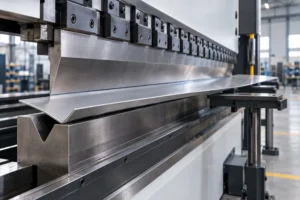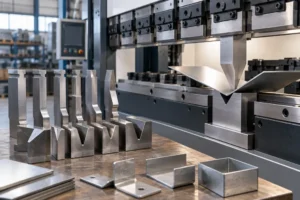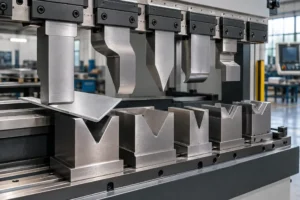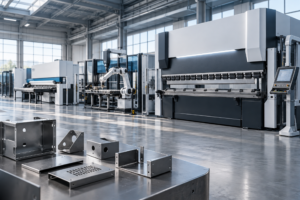
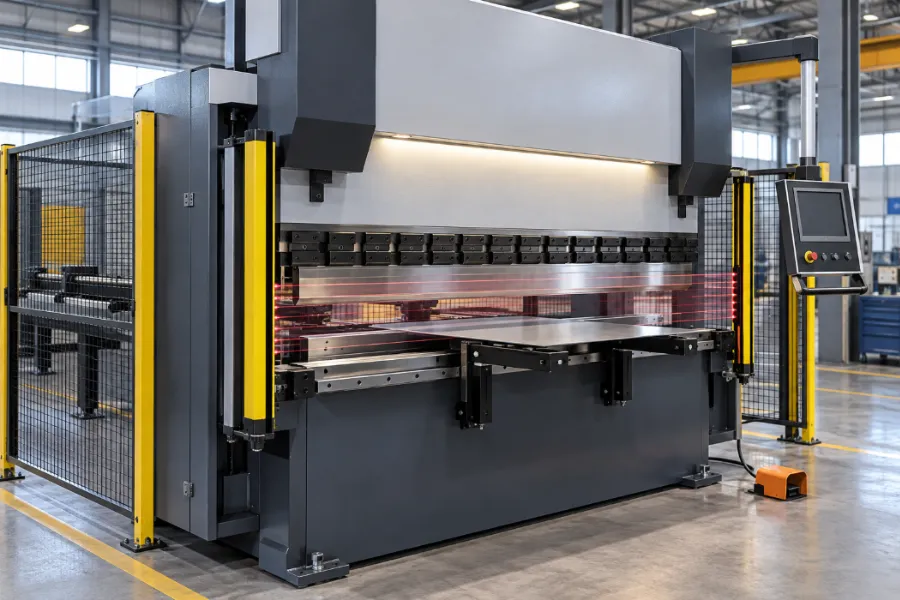
Press brake guarding protects operators from hazardous machine movement, especially at the point of operation where the punch and die close during bending.
A safeguarding system may combine physical guards, light curtains, laser-based protection, interlocks, two-hand controls, and rear-area protection. The appropriate arrangement depends on the machine configuration, tooling, workpiece geometry, operator access, and applicable safety requirements.
What Is Press Brake Guarding?
Press brake guarding refers to measures that prevent personnel from entering hazardous areas or cause the machine to enter an appropriate safe state when hazardous access is detected.
The point of operation is the primary concern, but a complete assessment also considers side openings, the rear backgauge, foot controls, tooling changes, setup, and maintenance.
For this reason, having one safety device does not automatically mean that a press brake has complete safeguarding. Each realistic access path to a hazardous movement needs to be considered.
What Hazards Does Press Brake Guarding Address?
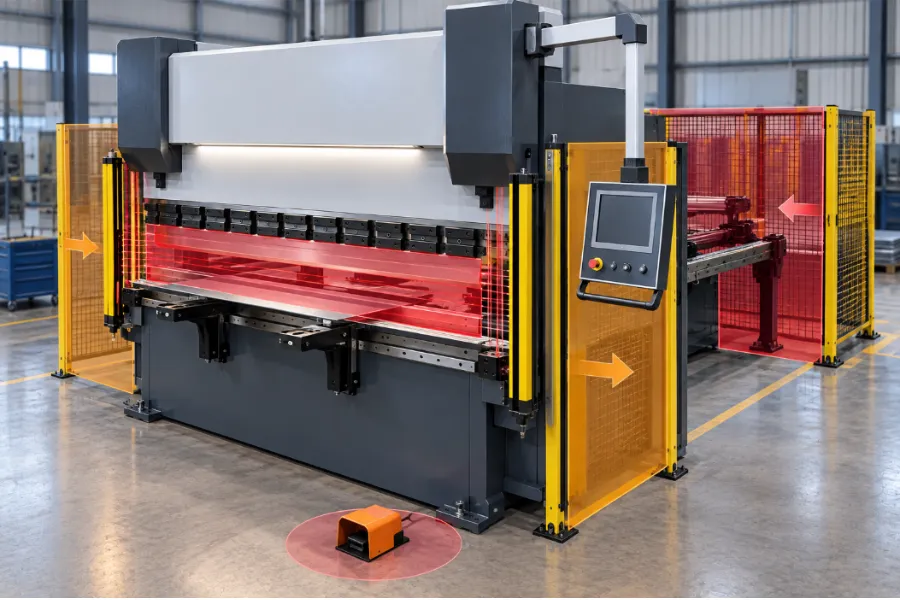
Point-of-Operation Hazards
The closing area between the punch and die is the main crushing and pinch-point hazard. Operators may work close to the tooling when positioning small parts or supporting workpieces, so the safeguarding method must account for how the machine is actually operated.
Side and Rear Access
Front protection does not automatically cover openings at the sides or behind the machine.
Side guards, rear barriers, interlocks, scanners, or other suitable measures may be required depending on the machine layout and how personnel can access the hazardous area.
The backgauge also creates a separate moving hazard on CNC press brakes. Rear protection therefore needs to be evaluated independently from front point-of-operation protection.
Foot Controls and Unexpected Cycling
Foot pedals can introduce unintended activation risks if they are damaged, poorly positioned, or deliberately bypassed. The control arrangement should allow the operator to interrupt the machine’s safety function when required.
Tooling and Maintenance
Press brake safety also depends on tooling condition and secure installation. Cracked, deformed, excessively worn, corroded, or improperly clamped punches and dies can create hazards during a bending cycle.
Maintenance introduces additional energy hazards. Electrical, hydraulic, and mechanical energy should be isolated before personnel enter hazardous areas, with appropriate mechanical support used where required for moving machine members.
Types of Press Brake Guarding
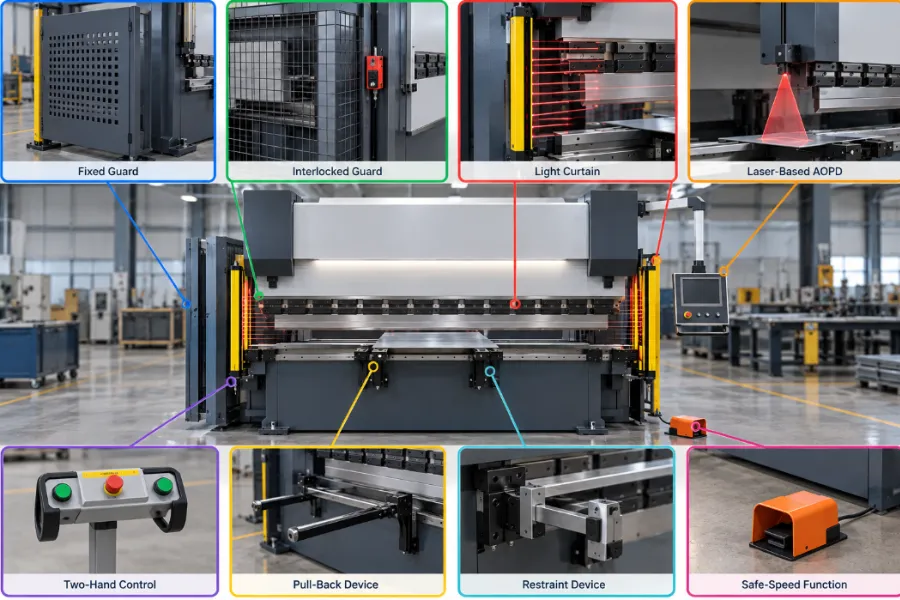
Common safeguarding approaches include:
| Guarding Type | Main Protection | Typical Consideration |
|---|---|---|
| Fixed guard | Side or rear access | Permanent restricted areas |
| Interlocked guard | Side or rear access | Areas requiring controlled access |
| Light curtain | Front access | General bending operations |
| Laser-based AOPD | Close to punch | Certain small or complex parts |
| Two-hand control | Operator hands | Specific operating conditions |
| Pull-back device | Operator hands | Specialized applications |
| Restraint device | Operator hands | Restricted applications |
| Safe-speed function | Machine motion | Setup or defined operating modes |
These methods are not interchangeable in every application. Selection should begin with the hazard and access path, then consider the machine’s movement, tooling, and production method.
Press Brake Safety Devices and How They Work
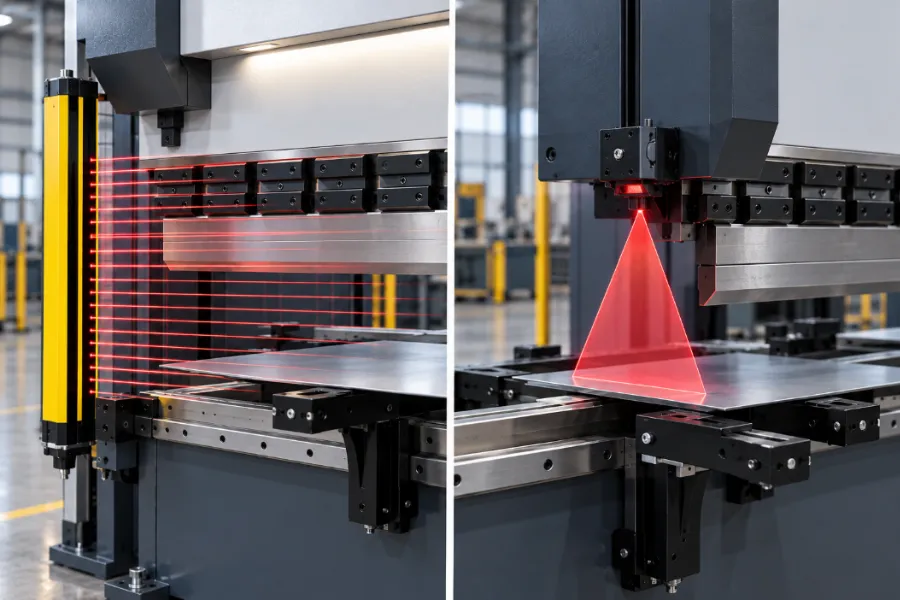
Light Curtains
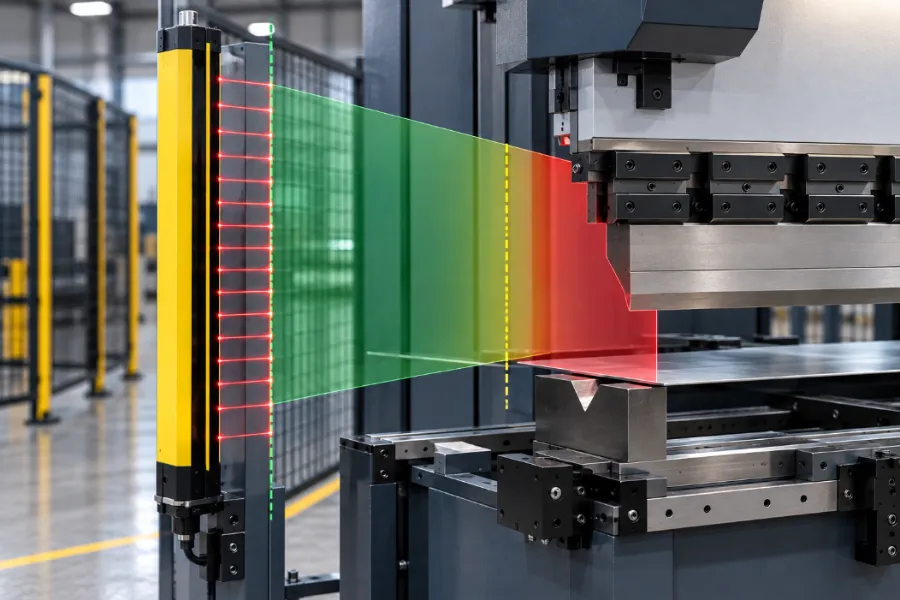
A light curtain creates a sensing field in front of the working area. When the field is interrupted during the applicable hazardous portion of the cycle, the safety system initiates its defined safety function.
The important engineering variable is the separation between the sensing field and the hazard. It must account for factors such as approach speed, device response time, control response time, and the machine’s actual stopping performance.
Muting may be needed for certain bending operations, but excessive or poorly configured muting can reduce the protected area. It should therefore be treated as part of the engineered safety function rather than simply a production convenience.
Laser-Based Guarding
Laser-based active optoelectronic protective devices can monitor an area closer to the punch than a conventional front light curtain.
This can be useful for certain small or complex parts where a front sensing field interferes with material handling. However, tooling height, tool geometry, sensing coverage, and machine stopping characteristics can affect whether a close-proximity system is suitable.
Laser protection should therefore be selected according to the actual machine and tooling rather than assumed to be universally superior to a light curtain.
Physical and Interlocked Guards
Fixed guards physically restrict access to hazardous areas. Interlocked guards can allow controlled access while preventing hazardous machine movement when the guard is open.
They are particularly relevant to side and rear areas because front point-of-operation protection does not necessarily cover every route into the machine.
Two-Hand Controls
Two-hand controls require the operator to use separate controls to initiate or maintain a machine function, keeping the operator’s hands away from the point of operation.
Their application is limited by the production process. They may not be practical when the operator needs both hands to position or support a workpiece, and they do not automatically protect other people working nearby.
Press Brake Guarding Requirements
Exact requirements depend on the jurisdiction, machine configuration, application, and applicable standards.
Point-of-Operation Protection
Hazardous access to the point of operation should be controlled through an appropriate safeguarding method. Operator training and warning labels support safe operation, but they should not be treated as substitutes for required engineering safeguards.
Safety Distance and Stopping Performance
A presence-sensing device must be positioned so the machine and safety system can reach the required safe state before a person can reach the hazardous point.
The required separation distance therefore depends on the actual response and stopping characteristics of the system. It should not be established by visual estimation alone.
Safety-Related Control Functions
Interlocks, emergency stops, presence-sensing devices, and other protective functions need reliable integration with the machine’s safety-related control system.
The required control architecture and performance should be determined from the applicable standards and risk assessment rather than assuming one performance level applies to every press brake.
Side and Rear Protection
The safeguarding assessment should consider realistic access routes around the entire machine. A front light curtain alone does not automatically protect side openings or the rear backgauge area.
Current Press Brake Safety Standards
Safety requirements vary by market.
In the United States, OSHA 29 CFR 1910.212 provides general machine guarding requirements, while OSHA CPL 02-01-025 provides guidance on point-of-operation guarding for power press brakes. ANSI B11.3-2022 is the current ANSI standard specifically addressing power press brakes.
It is important not to treat 29 CFR 1910.217 as the primary OSHA standard for press brakes because that section specifically excludes press brakes.
For European and international applications, ISO 6909:2026 is the current dedicated international safety standard for press brakes and replaces the earlier EN 12622 framework. Depending on the safety function, other relevant standards can include ISO 13849-1:2023 for safety-related control systems, ISO 13855:2024 for positioning safeguards relative to human approach, and the IEC 61496 series for electro-sensitive protective equipment.
Specific compliance requirements should be checked against the standards and regulations applicable to the machine’s market and installation.
Light Curtain vs. Laser Guarding
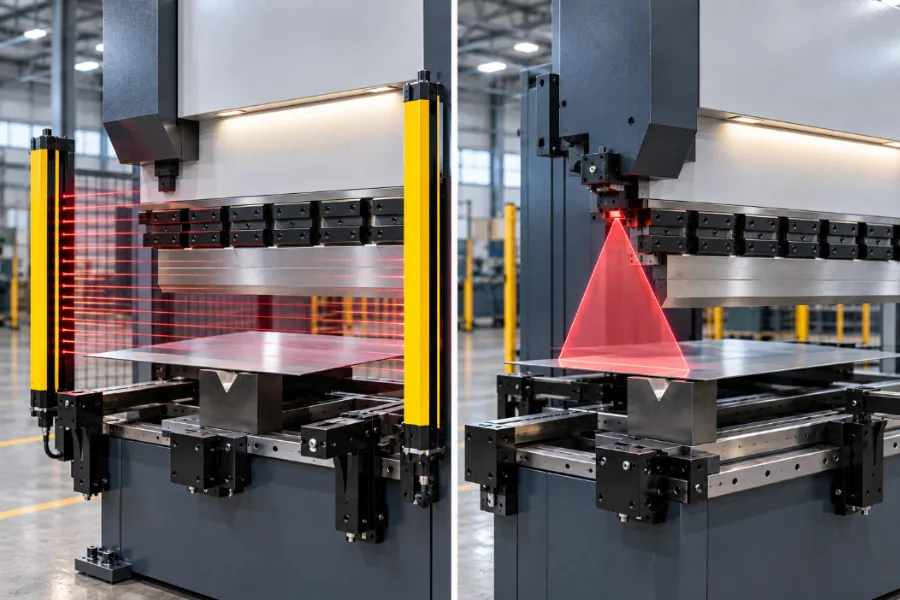
| Factor | Light Curtain | Laser-Based AOPD |
|---|---|---|
| Detection location | In front of working area | Close to punch |
| Typical use | General bending | Close-proximity applications |
| Small parts | May create interference | Can be more suitable in some applications |
| Safety distance | Critical | Application-dependent |
| Tooling influence | Generally manageable | Can affect sensing coverage |
| Main consideration | Placement and stopping performance | Tooling, geometry, and sensing coverage |
The choice should be based on workpiece geometry, operator position, tooling arrangement, machine movement, and safety-system performance rather than assuming one technology is always better.
How to Choose a Press Brake Guarding System
A practical selection sequence is:
Workpiece geometry → Operator position → Tooling → Machine movement → Hazard area → Safeguarding method → Verification
For conventional bending, front point-of-operation protection may be combined with side and rear guarding.
For small or complex parts, close-proximity laser protection may provide more flexibility when the machine and tooling are compatible. Large workpieces require additional consideration of operator position, material support, and movement paths.
CNC press brakes also require attention to moving backgauges and other automated axes that can create hazards outside the main bending zone.
Press Brake Guarding Inspection and Maintenance
Safeguarding must continue to perform its intended function throughout the machine’s service life.
Routine checks should cover guards, light curtains or laser systems, interlocks, emergency stops, foot controls, tooling clamping, and visible machine conditions.
Safety devices should be function-tested according to the manufacturer’s procedure and applicable requirements. Where protection depends on machine stopping performance, appropriate stop-time verification should also be performed.
Tooling should be checked for cracks, deformation, excessive wear, corrosion, and secure clamping. Damaged tooling should be repaired or replaced rather than returned to production.
Common Press Brake Guarding Mistakes
Relying Only on Operator Attention
Training is necessary, but it should not replace engineering safeguards where protection is required.
Ignoring Safety Distance
A functioning light curtain can still provide inadequate protection if its position does not account for the machine and safety system’s response and stopping performance.
Assuming Front Protection Covers the Entire Machine
Side and rear access need to be evaluated separately because they can expose personnel to different moving hazards.
Excessive Muting or Bypassing
Muting should support legitimate machine operation without unnecessarily disabling the sensing function. Safety devices should never be bypassed simply to reduce production interruptions.
Ignoring Tooling Condition
Electronic safeguarding does not eliminate hazards created by cracked, damaged, or improperly clamped tooling.
Press Brake Guarding Safety Checklist
Before operation, verify that:
- The point of operation is appropriately safeguarded.
- Side and rear access are controlled where necessary.
- Safety devices and interlocks function correctly.
- Required safety distances have been verified.
- Machine stopping performance is appropriately evaluated.
- Foot controls cannot be easily bypassed.
- Punches and dies are properly clamped.
- Tooling is free from significant damage.
- Safety devices have not been bypassed.
- Required inspection and maintenance records are maintained.
FAQ
What is press brake guarding?
Press brake guarding uses physical barriers, sensing devices, control functions, and other safeguards to prevent personnel from entering hazardous areas during machine operation.
What are the main types of press brake guarding?
Common methods include fixed and interlocked guards, light curtains, laser-based AOPDs, two-hand controls, pull-back devices, restraint devices, and certain safe-speed functions.
Are light curtains required on every press brake?
There is no single universal requirement that every press brake must use a light curtain. The appropriate safeguarding method depends on the machine, application, risk assessment, and applicable regulations.
What is the difference between a light curtain and laser guarding?
A light curtain generally protects an area in front of the machine, while laser-based protection can monitor an area closer to the punch. The suitable option depends on tooling, workpiece geometry, operator access, and machine performance.
Why is safety distance important?
A safeguarding device needs enough separation from the hazard for the machine and safety system to respond before a person can reach the danger zone. The required distance therefore depends on the actual response and stopping performance of the system.