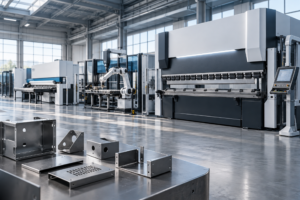
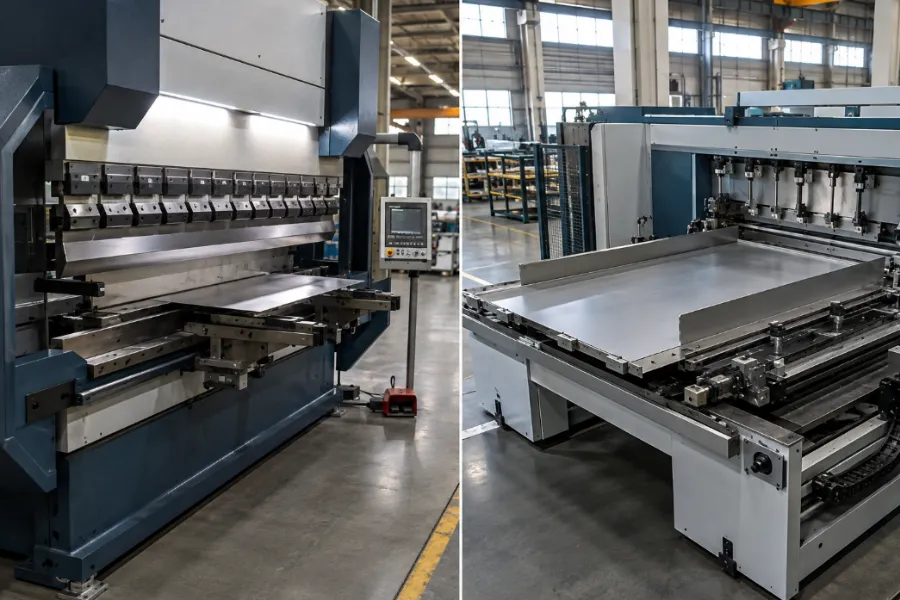
A press brake and a panel bender are both widely used sheet metal bending machines, but they solve different production problems. A panel bender is particularly effective for compatible panels, cabinets, enclosures, and repetitive multi-side parts, while a press brake offers broader flexibility across material thicknesses, tooling configurations, and part geometries.
The right choice depends less on which technology is more advanced and more on your part geometry, material and thickness, production mix, handling requirements, and automation goals. For some factories, the most productive solution may even be to use both machines for different part families.
Press Brake vs Panel Bender at a Glance
| Factor | Press Brake | Panel Bender |
|---|---|---|
| Bending principle | Punch + V-die | Clamping + folding blades |
| Part handling | Usually repositioned between bends | Sheet remains supported and is automatically manipulated |
| Tooling | Interchangeable punches and dies | More universal bending tooling |
| Geometry flexibility | Very high | Strong within its working envelope |
| Material range | Broad, including heavier work | Commonly optimized for sheet and panel work |
| Large panels | May require additional handling | Well suited to supported panel handling |
| Setup | Depends on tooling and job | Often faster for compatible parts |
| Automation | Manual, CNC, or robotic | Highly automated by design |
| Typical applications | Brackets, profiles, custom and mixed fabrication | Cabinets, enclosures, panels, lids and appliance components |
The key difference is therefore not a single specification. It is how each machine forms, supports, positions, and moves the workpiece throughout the bending sequence.
How Do Press Brakes and Panel Benders Work Differently?
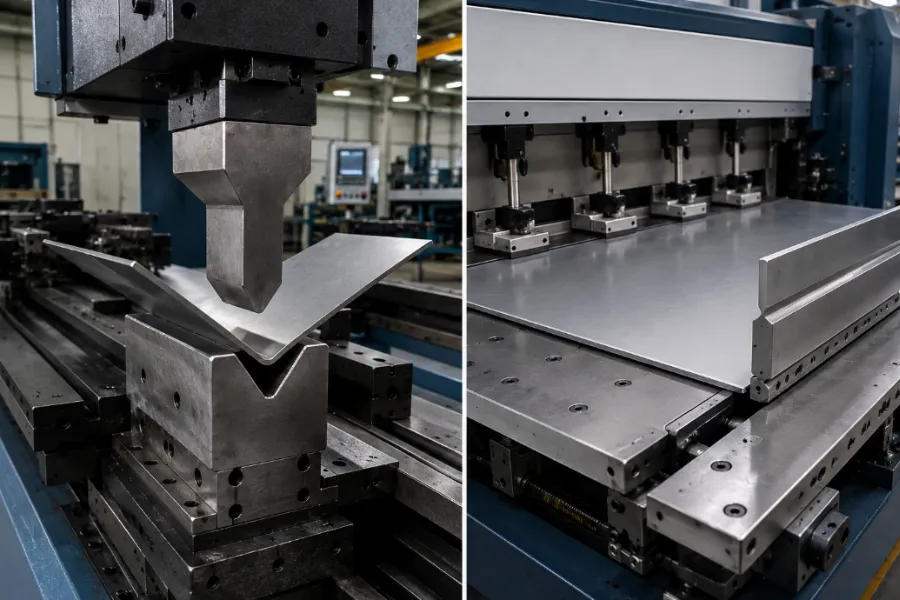
Press Brake: Punch-and-Die Bending
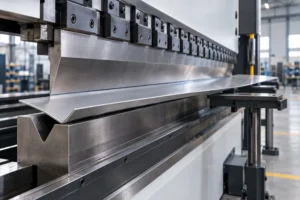
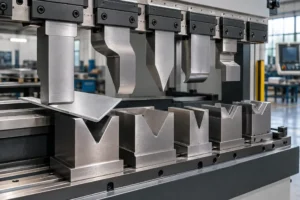
A press brake typically uses an upper punch and lower V-die. In air bending, the punch applies force from above while the material is supported by the two shoulders of the V-die, creating three primary contact points.
Bend results depend on variables such as material properties, thickness, bending length, V-die opening, punch geometry, penetration, and required radius. Modern CNC press brakes can combine programmable backgauges, crowning, angle-control technologies, and different tooling configurations to manage a wide range of jobs.
This tooling flexibility is a major strength. The trade-off is that the workpiece usually needs to be gauged and repositioned between bends, which can add handling time for large or multi-bend parts.
Panel Bender: Clamping and Folding
An automatic panel bender follows a different forming principle. The blank rests on a support table, a gauging or manipulation system positions it, and blank holders clamp the sheet while bending blades form the flange.
Because most of the sheet remains supported during panel bending, the operator does not normally need to lift and follow the complete workpiece through every bend. This can significantly reduce manual handling for large panels and repetitive multi-side components.
However, the blank holders, bending blades, clearance, and machine dimensions create a defined working envelope. Parts outside that envelope may be better suited to a press brake.
Part Geometry Is Often the First Selection Filter
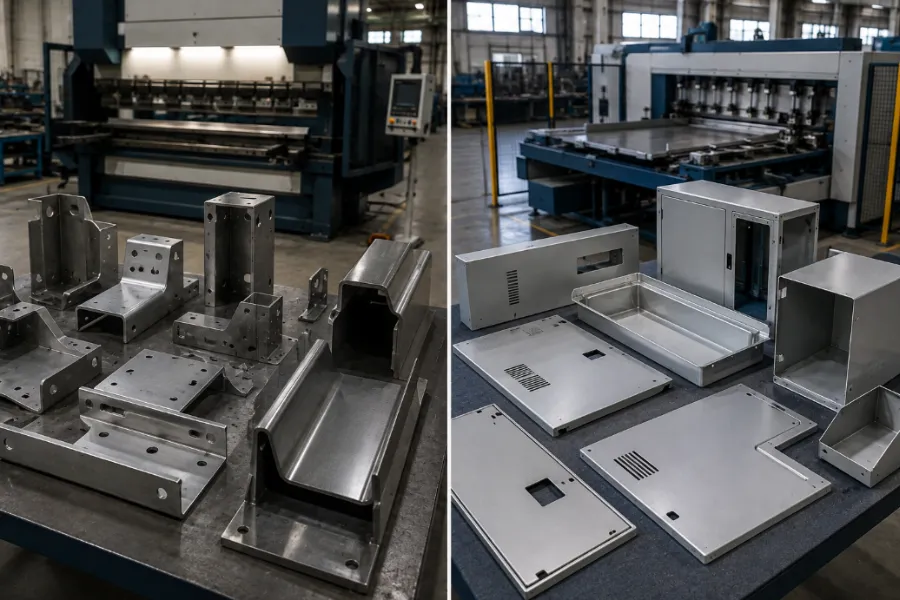
A highly automated machine is not necessarily the better investment if many of your parts cannot be processed efficiently on it. Before comparing speed or automation, examine the geometry of your actual production drawings.
Parts That Favor a Panel Bender
Panel benders are particularly attractive for relatively shallow sheet metal parts with multiple edge bends, including:
- Electrical enclosures and cabinets
- HVAC panels
- Appliance panels
- Doors and lids
- Architectural panels
- Shallow boxes
- Similar multi-side components
Consider an enclosure panel requiring bends along several edges. A press brake operator may need to support, rotate, gauge, and reposition the sheet repeatedly, while a compatible panel bender can keep the blank supported and manipulate it through successive bends.
The productivity advantage therefore comes from the complete process, not simply from how quickly the bending blade moves.
Parts That Favor a Press Brake
Press brakes are particularly useful when production includes greater variation in geometry, thickness, bend depth, and tooling requirements. Typical examples include brackets, deep channels, irregular or asymmetrical components, heavier parts, prototypes, and jobs requiring specialized punches or dies.
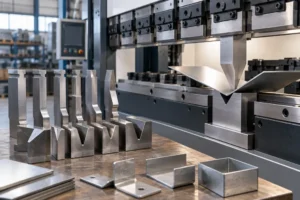
Interchangeable tooling allows the press brake to solve interference problems, accommodate different V openings and radii, and form geometries that may fall outside a panel bender’s clamping and clearance limits.
A useful early question is:
Does your production look more like panels and enclosures, or brackets and custom profiles?
Material Thickness, Bend Length, and Forming Capacity
After geometry, evaluate material and forming requirements.
For comparable V-die bending conditions, required press brake force increases approximately with the square of material thickness. If thickness doubles while the other major variables remain unchanged, the calculated bending force is roughly four times higher.
Force also increases with bending length and material tensile strength, while a larger V-die opening generally reduces the required force. This is why press brake selection should consider material → thickness → bend length → tooling → required force, rather than tonnage alone.
Panel benders are generally optimized around sheet and panel applications, but there is no universal thickness or size limit that applies to every machine. Allowable material, thickness, blank dimensions, bend length, flange height, and geometry must be checked against the specific model’s working envelope.
Which Machine Offers Higher Production Efficiency?
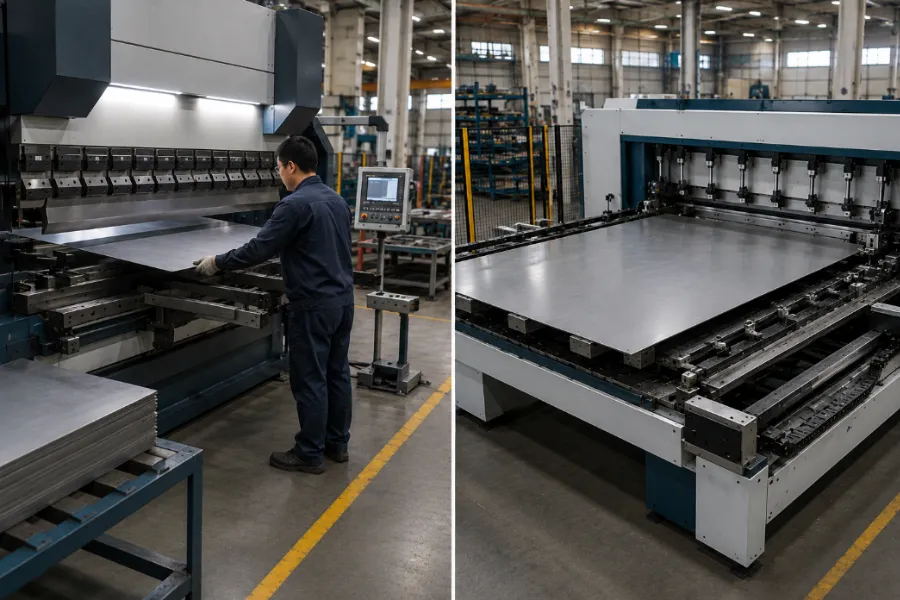
For compatible multi-bend panel parts, a panel bender can provide a substantial productivity advantage because it reduces the work required between bends.
A typical press brake process may involve:
Load → Gauge → Bend → Support → Reposition → Gauge → Bend → Unload
A compatible automated panel bending process can be closer to:
Load → Locate → Automated manipulation and bending → Unload
This difference becomes especially important with large, relatively thin sheets. Supporting and rotating them on a press brake can require considerable operator effort and, depending on the part, additional personnel or material-support equipment. These handling conditions should also be considered when evaluating press brake guarding, because workpiece size and operator position can affect how the point of operation is safeguarded.
For a simple component requiring only one or two bends, however, the productivity difference may be much smaller. Cycle time should always be evaluated using representative parts rather than generic claims about one machine being a fixed number of times faster.
Tooling and Setup: Flexibility vs. Standardization
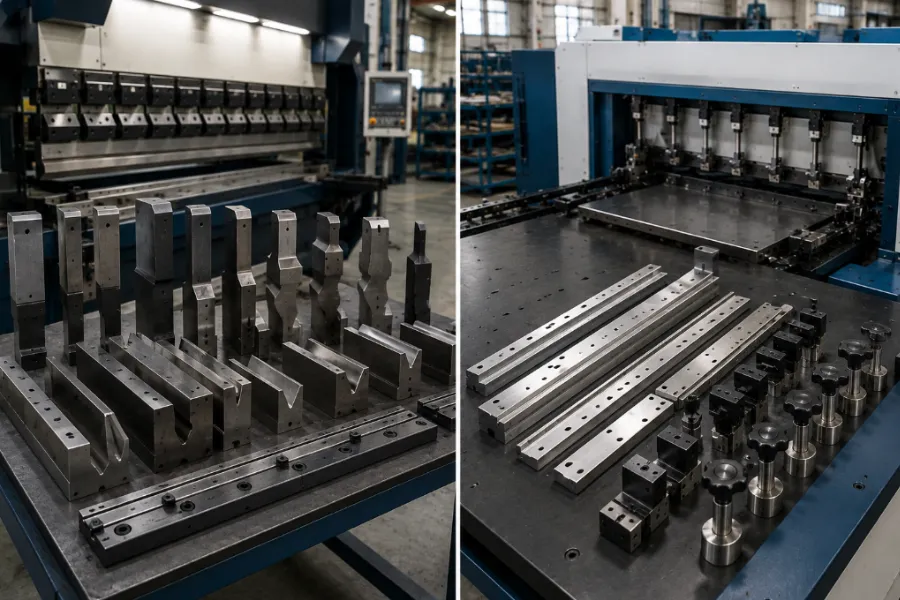
Press brake tooling is selected according to material thickness, V-die opening, inside radius, flange dimensions, interference, load capacity, and bend sequence. Different punches and dies give the machine considerable flexibility across changing jobs.
The cost of that flexibility is tooling inventory and setup. Shops processing many different geometries may spend additional time selecting, installing, aligning, and verifying tooling.
Panel benders typically use more universal bending tools and configurable blank-holding systems. For compatible part families, this can reduce conventional tooling changes and shorten changeovers.
Reduced physical tooling does not mean zero setup cost. Programming, part feasibility, software, machine configuration, auxiliary tooling, and automation requirements remain part of the production equation.
Accuracy, Repeatability, and Surface Quality
Both technologies can produce accurate parts when the machine, material, tooling, program, and process are properly controlled.
Press brake results can be influenced by material thickness variation, tensile properties, tooling geometry, machine deflection, and springback. Modern machines can use CNC backgauges, crowning, angle measurement, and other control technologies to compensate for these variables.
Part handling also matters. As components become larger or require more bends, repeated manual positioning can introduce another source of process variation. A panel bender reduces much of this interaction by supporting and positioning compatible blanks through the bending sequence.
Surface-sensitive materials deserve additional consideration. Conventional V-die bending can leave tooling marks under some conditions because the material interacts with the punch and die shoulders. Panel bending can reduce sliding contact in suitable applications, which may benefit stainless steel, coated sheets, and visible appliance panels.
Neither process, however, should be assumed to produce a mark-free surface under every condition.
High-Mix vs. High-Volume Is Not the Whole Story
A common rule says panel benders belong in high-volume production while press brakes belong in high-mix, low-volume shops. That distinction is too simple.
Automated setup and more universal tooling can make a panel bender effective for frequent job changes and smaller batches if those different parts remain inside its geometry and material envelope.
A factory producing many different enclosure models may therefore be both high-mix and well suited to panel bending. Another shop producing the same number of part numbers—but mixing thin covers, thick brackets, deep channels, prototypes, and unusual profiles—may benefit more from a press brake.
A better evaluation is:
Product Mix × Geometry Compatibility × Material Range × Setup Frequency
Production volume is only one part of the decision.
Press Brake vs Panel Bender Cost: Look Beyond Purchase Price
Machine price alone does not determine cost per part. A useful investment analysis should also consider:
- Tooling and setup
- Programming and software
- Operator labor
- Material handling
- Maintenance
- Floor space
- Scrap and rework
- Automation requirements
- Machine utilization
A panel bender can reduce handling and setup costs for compatible part families, but those benefits matter only if enough production can actually be routed to it.
A press brake may involve more tooling and handling for certain parts, yet its broader flexibility can allow a job shop to process a larger variety of orders with the same machine.
A faster machine is not automatically a better investment if only a small percentage of your parts fit its working envelope.
When Should You Choose a Panel Bender?
A panel bender deserves serious consideration when panels, cabinets, doors, lids, enclosures, and similar parts represent a significant share of production.
It becomes particularly attractive when parts require repetitive multi-side bending, large-sheet handling is creating a bottleneck, frequent conventional tooling changes reduce throughput, or the factory wants to reduce operator intervention and increase automation.
The strongest case exists when these part families remain within a predictable material, thickness, size, and geometry range.
When Should You Choose a Press Brake?
A press brake is generally the stronger choice when production requires broad flexibility across material thickness, geometry, and job type.
It is particularly suitable when heavier materials, deep profiles, irregular parts, specialized tooling, prototypes, and frequently changing custom work form an important part of the production mix.
If your application points toward a press brake, BENDORA recommends evaluating the machine from the workpiece backward. Material, thickness, maximum bending length, part geometry, required accuracy, production volume, and automation requirements should determine the configuration—not nominal tonnage alone.
Do You Need to Choose Only One?
Not necessarily. For some sheet metal manufacturers, press brakes and panel benders are complementary rather than competing technologies.
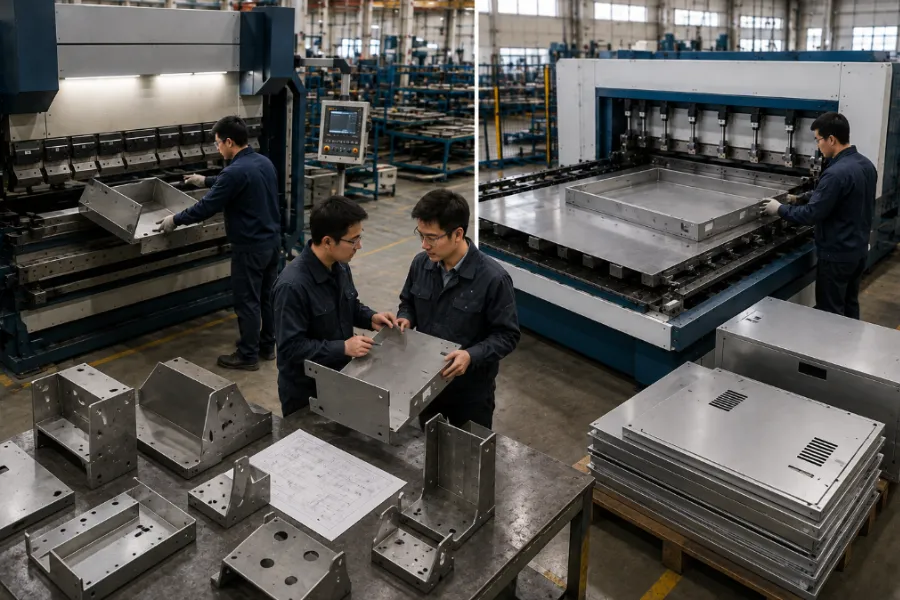
A panel bender can process compatible enclosure and panel families where automated handling provides the greatest productivity benefit. Press brakes can remain available for thicker material, deep or irregular profiles, special tooling, prototypes, and other work outside the panel bender’s effective range.
This creates a simple geometry-based routing strategy:
Panels and compatible enclosures → Panel Bender
Heavy, deep, irregular, or custom parts → Press Brake
Instead of forcing one machine to process every component, each part is routed according to the bending technology that best matches its requirements.
Practical Press Brake vs Panel Bender Selection Checklist
| Ask This Question | Usually Lean Toward |
|---|---|
| Are panels and enclosures a major share of production? | Panel Bender |
| Are repetitive multi-side bends common? | Panel Bender |
| Is large-sheet handling a bottleneck? | Panel Bender |
| Is reducing manual handling a major objective? | Panel Bender |
| Do material thicknesses vary widely? | Press Brake |
| Is heavier material common? | Press Brake |
| Are deep or irregular profiles common? | Press Brake |
| Do jobs require specialized tooling? | Press Brake |
| Are prototypes and custom jobs frequent? | Press Brake |
| Are both part families important? | Consider both |
Before investing, audit actual production drawings and classify representative parts by material, thickness, bend length, flange geometry, number of bends, handling requirements, batch size, and tooling.
If you are evaluating a press brake, providing BENDORA with your material, thickness, bending length, part drawings, required accuracy, production volume, and automation requirements allows the machine configuration to be evaluated against the real application.
Conclusion
The press brake vs panel bender decision is ultimately about manufacturing fit.
Panel benders are particularly effective for compatible panels, cabinets, enclosures, and repetitive multi-side sheet metal parts where supported handling and automation can reduce manual intervention. Press brakes provide a broader processing envelope for varied thicknesses, deep profiles, specialized geometries, heavier work, and custom fabrication.
Do not begin with machine speed or automation level. Begin with your parts:
Part geometry → Material and thickness → Bend requirements → Production mix → Handling → Tooling → Automation → Machine selection
For some factories, this analysis will point clearly toward one technology. For others, using a panel bender and press brake for different part families can provide the more practical production strategy.
FAQ
Is a Panel Bender Faster Than a Press Brake?
For compatible multi-bend panels and enclosures, a panel bender can deliver higher throughput by reducing manual repositioning, handling, and setup interruptions. The actual difference depends on part geometry, number of bends, loading method, machine configuration, and workflow.
Can a Panel Bender Replace a Press Brake?
Not for every application. Panel benders are highly productive within their working envelope, while press brakes generally offer greater flexibility for heavier materials, deep profiles, irregular components, specialized tooling, and custom fabrication.
Which Machine Is Better for Thick Sheet Metal?
A press brake is generally more suitable as material thickness and required forming force increase. Required capacity should still be calculated from material strength, thickness, bend length, V-die opening, and bending method rather than thickness alone.
Which Machine Is Better for Electrical Cabinets and Enclosures?
Panel benders are particularly well suited to many cabinets, doors, enclosure panels, and similar multi-side components. Deep boxes, unusual internal geometry, or parts outside the machine’s material and clearance limits may still require a press brake.
Can a Panel Bender Handle Small-Batch Production?
Yes, when the parts fit its working envelope. Automated setup and universal tooling can support frequent changeovers, so small batch size alone does not make a press brake the better choice. Highly varied materials, deep geometries, and specialized forming requirements may still favor a press brake.