Top 10 CNC Press Brake Manufacturers in the World
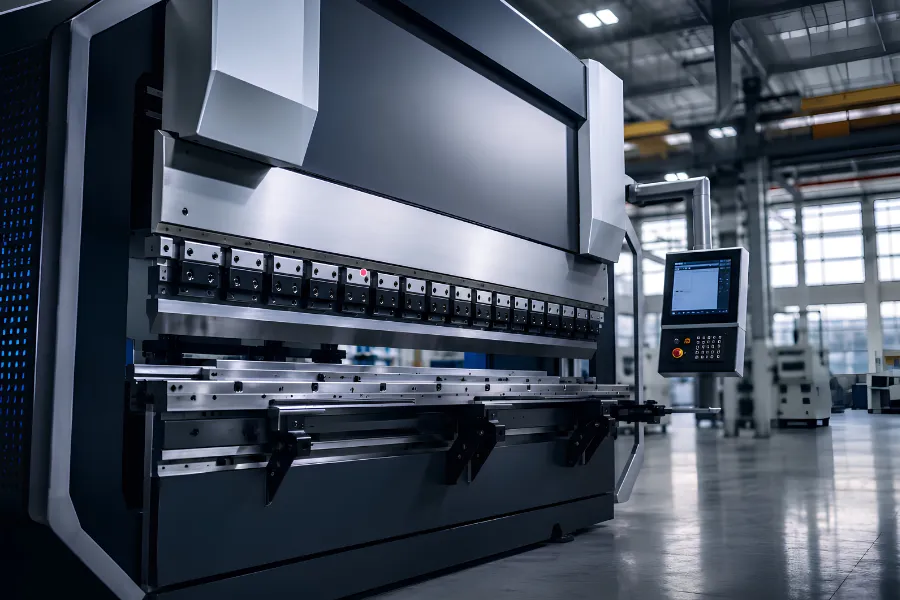
Table of Contents
Choosing among CNC press brake manufacturers requires more than comparing tonnage, bending length, or CNC axis count. Machine structure, tooling, angle correction, back gauge configuration, control software, automation, and material behavior can all influence bending consistency and productivity.
The manufacturers below represent different engineering approaches, from integrated precision bending and adaptive angle control to servo-electric technology and heavy-duty fabrication. This guide compares those differences to help fabricators and procurement teams build a more relevant supplier shortlist. The numbering is used to organize the comparison and does not represent a strict ranking by market share, company size, or overall technical capability.
CNC Press Brake Manufacturers at a Glance
| Manufacturer | Country | Differentiation | Production Fit |
|---|---|---|---|
| AMADA | Japan | Integrated precision bending | Complex, precision-focused sheet metal production |
| TRUMPF | Germany | Smart bending and automation | Automated and high-mix production |
| Bystronic | Switzerland | Digital, flexible bending | Flexible fabrication and automation |
| LVD | Belgium | Adaptive angle control | Production sensitive to material and angle variation |
| Prima Power | Italy | Servo-electric automation | Flexible, energy-conscious production |
| SafanDarley | Netherlands | Servo-electronic bending | Repetitive small-to-medium parts |
| Accurpress | Canada | Configurable industrial bending | Job shops and general fabrication |
| DURMA | Türkiye | Broad technology portfolio | Buyers comparing machine architectures |
| Cincinnati Incorporated | USA | Heavy-duty fabrication | Large parts and demanding industrial bending |
| BENDORA | China | Requirement-driven configuration | Application-specific press brake selection |
How We Selected These Manufacturers
The manufacturers were evaluated according to their CNC press brake portfolios, bending technologies, automation capabilities, engineering differentiation, application coverage, and relevance to industrial buyers. Official manufacturer and product information was prioritized when assessing company-specific capabilities. The supplied manufacturer materials show clear differences, including LVD’s adaptive bending systems, SafanDarley’s servo-electronic approach, and Cincinnati’s range of industrial press brake platforms.
Technical capability was considered in terms of production consequences rather than feature count. More tonnage, additional CNC axes, or faster ram movement are not automatically better. The right choice depends on the parts being produced, tooling, material behavior, production mix, accuracy requirements, and whether automation addresses a measurable production bottleneck.
1. AMADA
Headquarters: Japan
Website: www.amada.com
Specialization: Integrated precision bending and sheet metal manufacturing
Main Products: CNC press brakes, tooling, laser cutting and punching systems, automation, and manufacturing software
AMADA’s distinction is the way bending fits into a broader sheet metal manufacturing environment. For precision parts, repeatability depends not only on ram positioning but also on tooling, programming, setup, material behavior, and process control. This integrated approach makes AMADA particularly relevant when manufacturers want bending to work as part of a coordinated fabrication process rather than as an isolated machine operation.
Why Does AMADA Stand Out?
Integrated Bending System: AMADA combines press brake technology with tooling, controls, software, and broader sheet metal equipment, supporting more consistent process planning.
Precision-Oriented Production: The approach is relevant to complex components where repeatable results across changing jobs matter more than simply maximizing machine capacity.
Suitable For: Precision sheet metal manufacturers handling complex parts and companies seeking an integrated fabrication environment.
2. TRUMPF

Headquarters: Ditzingen, Germany
Website: www.trumpf.com
Specialization: Smart bending and automated production
Main Products: TruBend press brakes, automated bending systems, laser processing equipment, and connected manufacturing solutions
TRUMPF’s TruBend portfolio spans different production requirements, but its strongest distinction here is the combination of operator assistance and automation. This matters in high-mix production because setup, handling, positioning, and operator intervention can limit throughput more than the actual bending stroke.
Why Does TRUMPF Stand Out?
Operator Assistance: Bending assistance technologies can make complex operations easier to standardize and reduce dependence on individual operator experience.
Automation-Oriented Production: Automated handling and supporting systems can reduce non-productive time when labor, part volume, and product mix justify automation.
Suitable For: Smart factories, high-mix sheet metal production, and manufacturers with a clear business case for advanced bending automation.
3. Bystronic
Headquarters: Switzerland
Website: www.bystronic.com
Specialization: Digital and flexible bending production
Main Products: CNC press brakes, automated bending solutions, laser cutting equipment, and manufacturing software
Bystronic is particularly relevant where manufacturers want to connect bending with a more flexible digital production workflow. Its role is different from simply pursuing maximum automation: the focus is on adapting programming, equipment, and production processes as part families and batch sizes change.
This can be especially important for job shops and contract manufacturers where production flexibility matters as much as cycle speed.
Why Does Bystronic Stand Out?
Digital Workflow: Bystronic’s bending and software environment supports closer coordination between production preparation and machine operation.
Flexible Automation: Its approach is relevant to manufacturers that need automated production to accommodate changing components rather than one fixed high-volume part.
Suitable For: High-mix fabrication, digitally managed sheet metal production, and companies expanding automation while maintaining production flexibility.
4. LVD

Headquarters: Belgium
Website: www.lvdgroup.com
Specialization: Adaptive bending and in-process angle control
Main Products: Easy-Form, PPEB and Dyna-Press press brakes, robotic bending systems, and CADMAN software
LVD has one of the clearest technical identities in this comparison. Its Easy-Form technology uses an adaptive approach to bending, while its broader system combines machine control with the CADMAN software environment.
This matters because programmed ram position alone cannot completely eliminate variations caused by material properties, thickness, and springback.
Why Does LVD Stand Out?
Adaptive Angle Control: Easy-Form Laser can measure and correct the bending process, helping address angle deviations associated with actual material behavior rather than relying entirely on theoretical programming.
CADMAN Integration: CADMAN connects programming, tooling information, job preparation, and shop-floor production, adding a digital layer to the bending process.
Material batches do not always produce identical springback. LVD’s approach is therefore especially relevant when maintaining bend-angle consistency is more important than simply achieving a high nominal machine specification.
Suitable For: Precision bending where material variation, first-part accuracy, and repeatable bend angles are important.
5. Prima Power
Headquarters: Italy
Website: www.primapower.com
Specialization: Servo-electric and automated bending
Main Products: Servo-electric press brakes, hydraulic bending equipment, and automated sheet metal systems
Prima Power provides a distinct route into servo-electric bending while connecting the process with broader sheet metal automation. Electric drive architecture can be attractive when manufacturers prioritize repetitive operation, energy use, and reduced dependence on hydraulic systems.
However, drive technology should still be matched to required force, stroke, workpiece dimensions, tooling, and production conditions rather than treated as a universal indicator of machine performance.
Why Does Prima Power Stand Out?
Servo-Electric Technology: Its electric bending approach provides an alternative machine architecture for applications where production requirements fit this drive system.
Automation Integration: Bending can be incorporated into a wider automated production environment rather than remaining a standalone operation.
Suitable For: Flexible sheet metal production and manufacturers evaluating servo-electric bending alongside future automation requirements.
6. SafanDarley
Headquarters: Netherlands
Website: safandarley.com
Specialization: Servo-electronic bending technology
Main Products: E-Brake, H-Brake, and automated bending systems
SafanDarley has a recognizable identity around servo-electronic bending. Its bending portfolio gives buyers an opportunity to compare servo-electronic architecture with conventional hydraulic press brakes rather than evaluating machines only by tonnage or CNC axis count.
This distinction is particularly relevant when repetitive production, drive architecture, energy use, and process efficiency are part of the purchasing decision.
Why Does SafanDarley Stand Out?
E-Brake Technology: The servo-electronic architecture provides an alternative to conventional hydraulic press brakes for suitable force ranges, workpiece dimensions, and production conditions.
Bending-Focused Portfolio: Its specialization allows buyers to evaluate servo-electronic bending as a core technology rather than simply another option within a broad machine-tool catalog.
Electric architecture should still be evaluated against required tonnage, stroke, tooling, and part dimensions rather than selected on energy efficiency alone.
Suitable For: Buyers evaluating servo-electronic press brakes for repetitive small-to-medium sheet metal parts.
7. Accurpress
Headquarters: Canada
Website: www.accurpress.com
Specialization: Configurable industrial press brake systems
Main Products: CNC press brakes, shears, and fabrication automation
Accurpress provides industrial press brake platforms that can be configured around different fabrication requirements. This is particularly relevant to job shops, where the ideal machine may depend on balancing bending force, working length, controls, back gauge capability, and investment rather than purchasing the highest specification available.
Why Does Accurpress Stand Out?
Configurable Platforms: Machine selection can be matched more closely to actual fabrication requirements instead of maximizing specifications that may rarely be used.
Practical Industrial Fit: The approach suits facilities processing varied materials, part dimensions, and order quantities.
Suitable For: General fabrication, job shops, and industrial users seeking a configurable CNC press brake platform.
8. DURMA

Headquarters: Türkiye
Website: www.durmazlar.com.tr
Specialization: Broad multi-technology sheet metal machinery
Main Products: CNC hydraulic, servo/electric press brakes, and automated fabrication equipment
DURMA’s distinction is the breadth of its bending portfolio. Its different press brake platforms allow buyers to compare machine architectures, capacities, and investment levels without assuming that one bending technology is appropriate for every application.
This can be useful during the early supplier-shortlisting stage when the buyer has defined the workpiece but is still evaluating hydraulic, electric, or other machine configurations.
Why Does DURMA Stand Out?
Multiple Technology Paths: Different machine architectures allow buyers to select according to workpiece requirements and production priorities.
Broad Production Coverage: The portfolio supports different bending capacities and manufacturing environments, from general fabrication to more demanding production.
Suitable For: Buyers comparing different press brake technologies, capacities, and investment levels before committing to a machine architecture.
9. Cincinnati Incorporated

Headquarters: Harrison, Ohio, USA
Website: www.e-ci.com
Specialization: Industrial and heavy-duty bending
Main Products: XForm, Xi, Goform, and other CNC press brake platforms
Cincinnati Incorporated brings a strong industrial fabrication perspective. Its press brake platforms address different bending requirements, including applications involving larger components and demanding production environments.
For large or thick workpieces, however, simply choosing more tonnage is not enough. Frame rigidity, deflection management, tooling capacity, working length, and material handling become increasingly important as part size grows.
Why Does Cincinnati Incorporated Stand Out?
Heavy-Duty Fabrication: Its press brake portfolio is relevant to large workpieces, thick materials, and demanding industrial bending environments.
Application-Based Platforms: Its range also demonstrates that industrial fabrication does not always require the largest machine; capacity should follow the workpiece.
Suitable For: Heavy fabrication, large components, thick plate, and industrial applications requiring robust bending equipment.
10. BENDORA

Headquarters: China
Website: lzhlzhlzh.site
Specialization: Requirement-driven CNC press brake configuration
Main Products: CNC hydraulic, servo-electric, hybrid, tandem, heavy-duty, and customized press brake solutions
BENDORA focuses on matching machine configuration to workpiece and production requirements. Material, thickness, bending length, part geometry, accuracy requirements, and production volume can be evaluated before deciding on tonnage, CNC configuration, back gauge, crowning, tooling, and automation.
This approach is relevant when a standard machine specification does not closely match the buyer’s actual production conditions.
Why Does BENDORA Stand Out?
Workpiece-Based Evaluation: Selection begins with what needs to be bent rather than automatically moving toward a larger or more highly specified press brake.
Application-Oriented Configuration: Different press brake architectures can be evaluated according to force, productivity, flexibility, automation, and investment priorities.
Suitable For: Buyers seeking a CNC press brake configuration based on specific workpieces, production volumes, and automation requirements.
How to Choose a CNC Press Brake Manufacturer
The manufacturer shortlist should begin with the bending process, not the brand name. Machine specifications, V-die opening, tooling, bending sequence, and required force need to be evaluated together because changing one variable can affect several others.
Step A — Define the Workpiece First
Start with material, thickness, maximum bending length, required inside radius, minimum flange, and part geometry. These factors determine much of the required machine capacity and tooling.
For example, V-die opening influences the achievable bend radius, required force, and minimum flange. A useful reference for V-bending is a minimum flange of approximately 0.7V, although actual tooling and processing conditions should always be verified.
Buyer Takeaway: Build the machine specification from representative parts rather than catalog maximums.
Step B — Match Tonnage With Tooling
Required bending force increases with bending length and material tensile strength, rises approximately with the square of material thickness, and decreases as V-die opening increases.
A general relationship is:
P = C × L × t² × σb / V
This means a narrower die opening can increase required force, while simply purchasing a higher-tonnage machine does not solve poor tooling selection.
Buyer Takeaway: Evaluate tonnage, V-die opening, material, and bending length as one system.
Step C — Evaluate the Complete Accuracy System
CNC positioning alone does not determine the finished bend angle. Springback varies with material, thickness, bend radius, and processing conditions, while tooling, crowning, machine deflection, back gauge performance, and angle correction also influence results.
This is why adaptive angle measurement and correction become meaningful when material variation creates a measurable production problem.
Buyer Takeaway: Compare how the manufacturer manages the complete bending process, not only nominal CNC repeatability.
Step D — Automate the Real Bottleneck
Faster ram movement does not necessarily produce more parts per shift. In high-mix production, programming, tooling changes, positioning, part handling, and operator intervention can consume substantial time.
Automatic tool changing, robotic handling, or digital programming make the most sense when they remove one of these measurable constraints. Low-volume operations may not receive the same return from advanced automation.
Buyer Takeaway: Choose automation based on production bottlenecks rather than feature count.
Step E — Include Tooling in the Manufacturer Evaluation
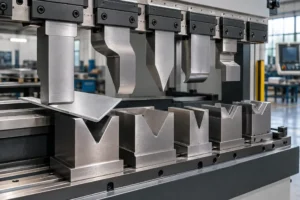
Punch geometry, die opening, tool load capacity, clamping, and workpiece clearance directly affect what the press brake can produce. The lower die is particularly important because its opening influences force, bend radius, minimum flange, and potentially surface condition.
Quick-clamping or specialized tooling may also matter when frequent setup changes, hemming, short flanges, complex geometry, or surface marking are production concerns.
Buyer Takeaway: Evaluate the machine and tooling as one bending system.
Which Manufacturer Fits Your Production?
| Production Requirement | Manufacturers to Consider |
|---|---|
| Integrated precision fabrication | AMADA |
| Smart bending and advanced automation | TRUMPF |
| Flexible digital production | Bystronic |
| Adaptive angle correction | LVD |
| Servo-electric automated bending | Prima Power |
| Servo-electronic bending | SafanDarley |
| Configurable job-shop production | Accurpress |
| Broad technology choices | DURMA |
| Heavy-duty fabrication | Cincinnati Incorporated |
| Application-specific configuration | BENDORA |
The table is an application guide rather than a quality ranking. Several CNC press brake manufacturers may fit the same project, and local service, tooling availability, operator skills, spare parts, and lifecycle support should also influence the final shortlist.
What Information Should You Prepare Before Requesting a Quote?
A useful RFQ should allow a press brake supplier to evaluate the bending process rather than simply quote a requested tonnage.
Prepare the material and tensile strength when available, thickness range, maximum bending length, representative part drawings, required inside radius and minimum flange, production volume and product mix, required tolerances, and automation or surface-quality requirements.
Part drawings are especially valuable because they allow suppliers to evaluate tooling interference, bending sequence, machine capacity, and back gauge requirements. For complex work, providing finished drawings together with flat patterns can produce a more useful technical proposal than specifying tonnage and working length alone.
Conclusion
The best CNC press brake manufacturer for a project is the one whose machine architecture, tooling approach, control capabilities, automation, and support fit the actual production requirement.
Start with representative workpieces and determine material, thickness, bending length, geometry, accuracy, tooling, and production volume. Then compare manufacturers according to the capabilities that solve those requirements. This approach produces a more meaningful supplier shortlist than selecting a press brake according to brand recognition, maximum tonnage, CNC axis count, or automation features alone.
FAQ
What is the difference between a CNC press brake and a conventional press brake?
A CNC press brake uses programmable control for functions such as ram movement, back gauge positioning, and stored bending programs. More advanced systems may also provide graphical programming, multi-axis control, angle correction, and integration with automated production.
How much tonnage does a CNC press brake need?
Required tonnage depends on material tensile strength, thickness, bending length, V-die opening, and bending method. Because force increases approximately with the square of material thickness under comparable conditions, small changes in thickness can significantly affect machine requirements.
Is a servo-electric press brake better than a hydraulic press brake?
Neither architecture is universally better. Servo-electric machines can suit certain force ranges, part sizes, cycle requirements, and energy priorities, while hydraulic systems remain relevant for other stroke, force, and heavy-duty applications. Selection should follow the workpiece and production process.
Which CNC press brake manufacturers offer automation?
Manufacturers such as TRUMPF, Bystronic, Prima Power, LVD, and SafanDarley provide different approaches to automated bending. The better choice depends on whether the production bottleneck involves programming, tooling changes, material handling, labor availability, or high-volume repetitive production.
Does a press brake with more CNC axes provide better accuracy?
Not necessarily. Additional axes can improve positioning flexibility for complex components, but final bending accuracy also depends on tooling, material behavior, machine deflection, crowning, back gauge performance, and process control. Axis count should follow part geometry rather than serve as a general quality indicator.
What should I compare besides the press brake itself?
Evaluate tooling compatibility, local service capability, spare-parts availability, operator training, CNC support, commissioning, automation integration, and lifecycle maintenance. Two machines with similar specifications can create very different production experiences if their tooling and support ecosystems differ.